
The Most Striking Number in Psychedelic Research
When Matthew Johnson, Albert Garcia-Romeu, and their colleagues at Johns Hopkins published their initial psilocybin smoking cessation pilot data, the result attracted attention that extended well beyond the psychedelic research community. The headline figure — 80% of participants had stopped smoking at six-month follow-up — was extraordinary by any benchmark.
Standard nicotine replacement therapy has long-term quit rates in the 10–20% range. Varenicline (Chantix), the most effective pharmacological cessation tool, produces quit rates of 30–40% at one year in favorable studies. Behavioral intervention alone is lower. The 80% figure from the Hopkins pilot was so far outside the normal range that it prompted both intense scientific interest and significant skepticism.
Understanding what that number actually means — what the study did, why the results were so strong, whether they hold up in larger trials, and what this means for someone trying to quit smoking — requires going beyond the headline.
The Original Hopkins Pilot Study
The study, published in the Journal of Psychopharmacology in 2014, enrolled 15 participants who smoked at least 10 cigarettes per day, had tried to quit at least once before, and wanted to quit. This was a small, open-label pilot with no control group — a design appropriate for establishing safety and feasibility, not for definitive efficacy claims.
Participants received two to three psilocybin sessions (25mg or 30mg in capsule form, supported by trained monitors) alongside a structured cognitive behavioral therapy (CBT) smoking cessation program. The psilocybin sessions were timed to the target quit date and the weeks following it.
At six months, 12 of 15 participants (80%) were confirmed abstinent via carbon monoxide breath testing. This is point-prevalence abstinence — not continuous abstinence — and it was confirmed biochemically, not self-reported. At twelve months, the abstinence rate was 67%. A follow-up at 16 months showed continued high rates of abstinence.
These were not casual smokers who were already predisposed to quit. Participants had smoked an average of 19 cigarettes per day for over 31 years. Most had made multiple previous quit attempts. This was a chronically entrenched behavior, and psilocybin-assisted therapy appeared to have broken through it in a way that other interventions had not.

Why Does Psilocybin Work for Addiction?
The mechanism is not fully established, but several converging lines of evidence point toward what is happening.
Disruption of rigid cognitive patterns. Addiction research increasingly frames substance dependence as a disorder of habitual, rigid cognition — the brain has learned a behavioral loop (cue → craving → use → relief) that becomes automatic and resistant to change. Psilocybin's acute effect on brain network connectivity appears to dramatically reduce the rigidity of these patterns, temporarily increasing what researchers call "psychological flexibility" or cognitive entropy. The brain becomes more open to new patterns.
Mystical experience as a mediating variable. The Hopkins team found that the intensity of the mystical experience during psilocybin sessions was one of the strongest predictors of long-term abstinence. Participants who reported more complete mystical experiences had higher quit rates. This is consistent with findings across psilocybin's therapeutic applications: the depth and character of the experience correlates with outcomes in ways that don't fit a simple pharmacological model.
Changes in self-concept. Many successful quitters — both in the Hopkins study and in qualitative research — describe a shift in how they relate to their identity as a smoker. Rather than an ongoing struggle to resist a craving that feels intrinsic to who they are, many report that psilocybin produced a shift in perspective that allowed them to see smoking as something external and foreign to their deeper self. This isn't mystical hand-waving — it reflects measurable changes in self-related processing in the brain's default mode network.
Reduced cue reactivity. Some neuroimaging research suggests that psychedelics may reduce the brain's conditioned response to addiction-related cues, though this is less well established in humans than in animal models.
The Phase 2 Randomized Controlled Trial
The Hopkins pilot was promising enough to warrant a larger, more rigorous study. A Phase 2 randomized controlled trial comparing psilocybin-assisted therapy to nicotine patch-assisted therapy in 67 participants was completed and published in 2022. Results confirmed the direction of the pilot: psilocybin-assisted therapy showed higher biochemically verified abstinence rates than nicotine replacement at 6, 12, and 26 weeks.
The study's design allowed researchers to control for the structured therapeutic support by providing CBT to both groups. This helps isolate psilocybin's contribution beyond therapy alone, though a "pure pharmacology" comparison without any therapy is not practically or ethically straightforward.
As of 2026, a larger Phase 3 trial is in planning stages, with Usona Institute and Johns Hopkins among the institutions working toward it. FDA approval specifically for smoking cessation would require Phase 3 data, and that timeline extends several years out.
The Protocol: What the Therapy Actually Involves
The Hopkins smoking cessation protocol is highly structured. Understanding its components helps explain why it is unlikely to be replicated by simply taking psilocybin without support.
Intake and screening. Participants are screened for psychiatric contraindications, cardiovascular health, and medications. The protocol excludes people with personal or family histories of psychosis, bipolar I disorder, and severe cardiovascular conditions.
Preparation sessions. Two to three meetings with therapeutic monitors before the first dosing session. These sessions cover the participant's smoking history, motivation to quit, life history, therapeutic goals for the session, and practical information about what to expect during psilocybin's effects. Critically, the therapeutic relationship is established before any psilocybin is administered. Rapport, trust, and an understanding of the facilitators' role are built in advance.
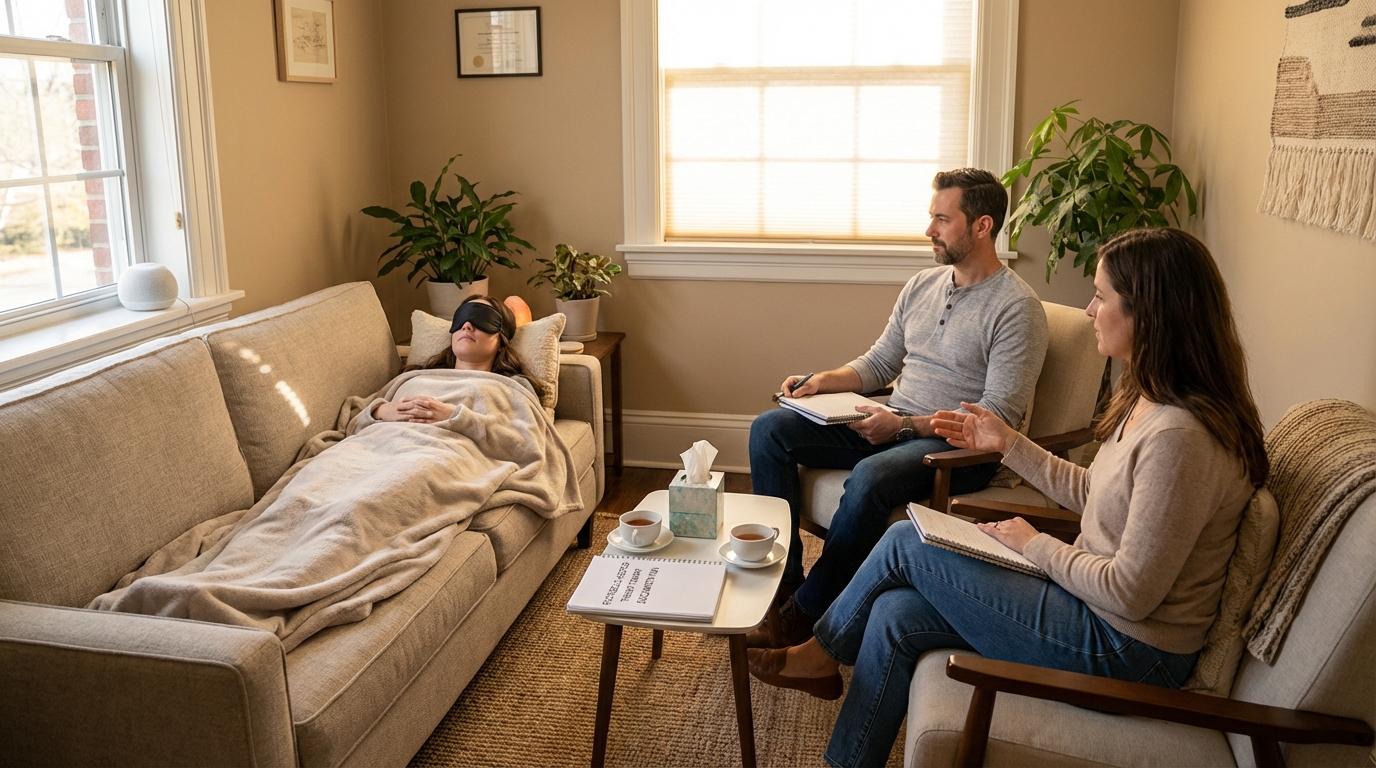
Dosing sessions. Two to three sessions spaced several weeks apart. Participants receive 20–30mg psilocybin (or equivalent) in a monitored setting, lying on a couch with eyeshades and a music playlist, with two trained monitors present. The monitors do not direct the experience but are available to provide support, grounding, and reassurance if needed. Sessions last approximately 5–7 hours.
Integration sessions. Follow-up meetings after each dosing session to process what arose during the experience and link it to cessation goals. Participants discuss insights, changes in perspective, and what the experience meant to them.
The quit date. The target quit date is set to coincide with the second psilocybin session. This is not incidental — the session's effects on cue reactivity, self-perception, and cognitive flexibility are leveraged precisely at the moment of behavioral change.
The Role of Set and Setting in Cessation Outcomes
The Hopkins protocol is not just about psilocybin. It is psilocybin embedded within a comprehensive behavioral support structure. This distinction matters practically: taking psilocybin without preparation, without a structured quit plan, without integration support, and without experienced monitors is a fundamentally different intervention — and there is no evidence that it produces comparable results.
Participants who have tried to quit "on their own" with psilocybin sometimes report partial benefits. The therapeutic framework appears to amplify and direct the effects toward the specific behavioral goal in ways that an unstructured experience does not reliably replicate.

How to Access Psilocybin-Assisted Smoking Cessation in 2026
Clinical trials. Clinicaltrials.gov lists ongoing studies at Johns Hopkins, NYU, and other institutions. Eligibility criteria typically include smoking at least 10 cigarettes per day, motivation to quit, no contraindicated psychiatric or medical history, and willingness to participate in preparatory and integration sessions. Trial participation is free. This is the highest-quality option available.
Oregon licensed services. Oregon's licensed psilocybin service centers are not authorized to make medical claims or provide treatment for specific conditions, but they can legally provide psilocybin services to adults 21+ who seek them. Some licensed facilitators have backgrounds in addiction counseling and can structure their services around a cessation goal. This is legal, above-board, and allows for a supported experience — but it is not a clinical trial and does not include the full Hopkins protocol.
Colorado's framework. Colorado's natural medicine access centers are beginning to operate under Proposition 122's framework, with similar provisions to Oregon's. The same considerations apply.
International retreats. Jamaican and Dutch retreat centers can legally provide psilocybin-assisted experiences, and some have developed cessation-oriented programs modeled on the Hopkins approach. Quality varies significantly, and the due diligence considerations outlined in a retreat-selection guide apply fully here.
What Doesn't Work: The "I'll Just Try It" Approach
The data from the Hopkins study cannot be extrapolated to unsupported recreational or self-directed psilocybin use. The 80% quit rate comes from a specific, multi-week structured protocol with preparation, high-dose supervised sessions, and integration support. Taking psilocybin mushrooms without this framework while hoping to quit smoking is unlikely to produce comparable results, and may produce disorienting or difficult experiences without any benefit for the target goal.
This is not a moral argument against self-directed use. It is a practical argument about what the evidence actually supports. For someone seriously motivated to use psilocybin to quit smoking, pursuing the structured pathway — a clinical trial, a licensed service with integration support, or a high-quality retreat program — significantly improves the probability of a meaningful outcome.
Harm Reduction Notes for the Smoking Cessation Context
If you are currently taking varenicline (Chantix) or bupropion (Wellbutrin, Zyban), discuss these with the clinical team before any psilocybin session. Bupropion affects dopamine and norepinephrine systems and has complex interactions with serotonergic agents. There is limited direct interaction data for bupropion and psilocybin, but caution is warranted.
Nicotine replacement (patch, gum, lozenge) has a lower interaction concern with psilocybin and is sometimes used in bridging protocols.
The psilocybin experience itself is demanding. People who have previously found high-dose psychedelic experiences very difficult may find this protocol challenging. Lower doses in earlier sessions allow for familiarization before the higher doses used at the cessation target date.
Where the Science Is Heading
The FDA has granted psilocybin for treatment-resistant depression Breakthrough Therapy designation. A separate application specifically for nicotine use disorder would require its own Phase 3 data — data that does not yet exist at the scale the FDA requires. The realistic timeline for any FDA-approved psilocybin-based cessation treatment is likely 5–8 years from now, assuming continued positive results.
In the interim, the most meaningful access pathway for most people is either clinical trial enrollment or the emerging licensed service frameworks in Oregon and Colorado. The Hopkins data is real and compelling. The support structures around it are inseparable from what made it work.