
Why Psilocybin Reduces Anxiety: The Science Behind the Calm
Across multiple clinical populations — cancer patients facing death, people with generalized anxiety disorder, individuals with social anxiety — psilocybin consistently reduces anxiety. Often dramatically, often persistently. The mechanisms are multiple and overlapping. Here's what we know.
The Amygdala Effect
The amygdala is the brain's primary threat-detection structure. In anxiety disorders, the amygdala is hyperreactive — responding with excessive alarm to stimuli that don't objectively warrant it. This hyperreactivity is the neural correlate of chronic anxiety.
Robin Carhart-Harris and colleagues at Imperial College London have shown that psilocybin reduces amygdala reactivity to threat-related stimuli. In brain imaging, the amygdala response to fearful faces is significantly blunted under psilocybin. This effect appears to persist beyond the acute session — imaging weeks after treatment shows normalized amygdala reactivity compared to pre-treatment baseline.
The clinical translation: the felt sense of anxiety — the hypervigilance, the anticipatory fear, the bodily alarm — is reduced because the neural trigger for those responses has been downregulated.
Default Mode Network Disruption
The default mode network (DMN) is active during self-referential thought — the internal narrative that defines how we see ourselves, our vulnerabilities, and our threats. In anxiety, the DMN runs a particularly toxic story: replaying past failures, anticipating future catastrophes, constructing and maintaining an anxious self-concept.
Psilocybin is one of the most potent known suppressors of DMN activity. Under psilocybin, the usually-dominant internal voice quiets — sometimes profoundly. People describe this as a relief from the relentless internal chatter that maintains anxiety. The self temporarily steps back.
Importantly, this disruption appears to reset the DMN's default activity patterns. Post-treatment imaging shows reduced DMN connectivity that persists weeks to months after a single session. The brain, briefly freed from its anxious default, appears to settle into a new equilibrium with lower anxiety load.
Neuroplasticity and the Capacity for Change
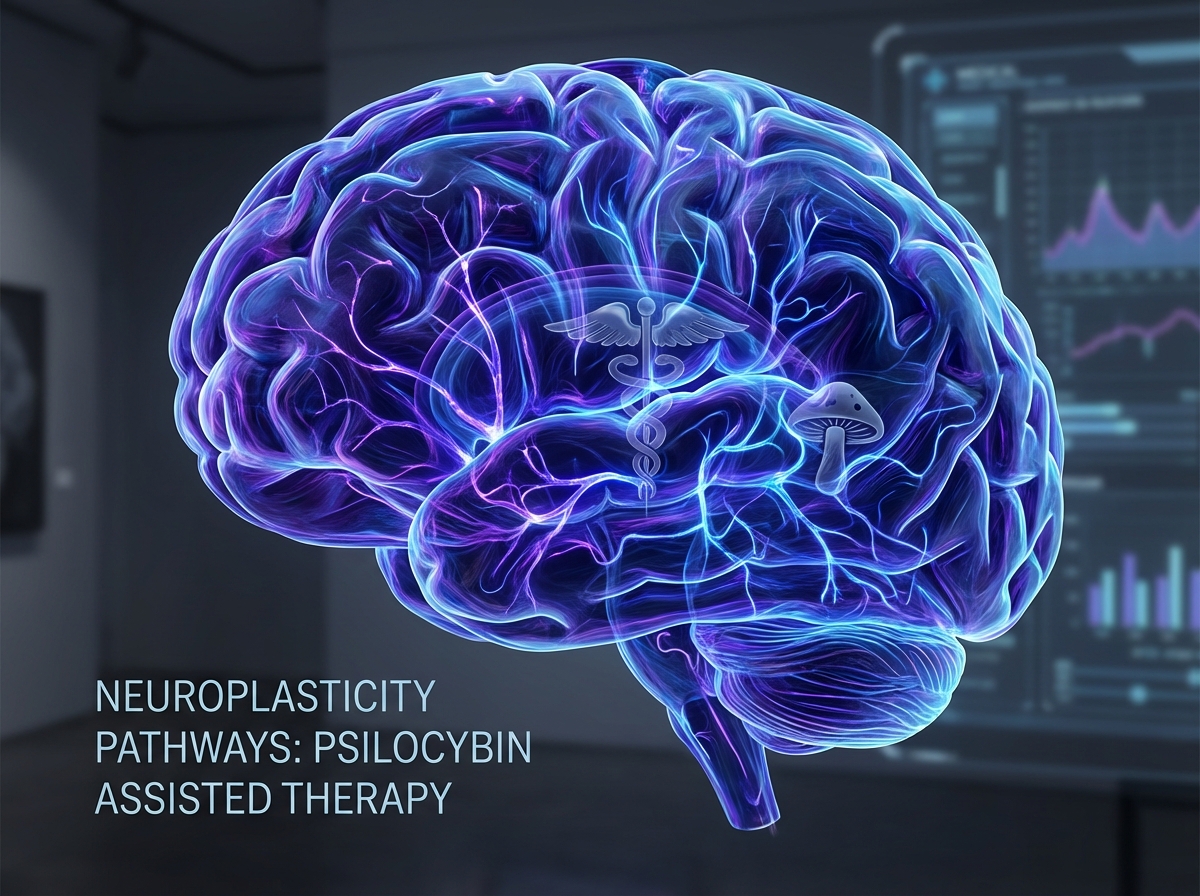
Psilocybin reliably increases BDNF (Brain-Derived Neurotrophic Factor), a protein that supports neuronal survival, growth, and the formation of new synaptic connections. BDNF is reduced in anxiety and depression; increasing it is associated with recovery.
The practical consequence: after a psilocybin session, the brain is in a heightened plasticity state — more capable of forming new associations and breaking old ones. New experiences can be encoded more readily; old anxious associations lose some of their grip.
This is why behavioral exposure therapy in the days and weeks following a psilocybin session may be particularly effective: the brain is primed to learn. Integration therapy that includes anxiety-reducing behaviors, exposure to previously avoided situations, and new relational patterns leverages this window.
The Mystical Experience and Anxiety Reduction
The Hopkins cancer anxiety trials (Griffiths et al., 2016; Grob et al., 2011) found that the single greatest predictor of anxiety reduction was the depth of the mystical experience. Participants who had profound experiences of unity, transcendence, and noetic insight showed the greatest and most sustained reduction in anxiety.
The mechanistic explanation for this is not fully established, but the clinical observation is consistent: something about the mystical experience specifically — not just the pharmacological effects — produces lasting anxiety reduction. The prevalent theory is that a felt encounter with a reality larger than the anxious self changes the relationship to death, uncertainty, and loss in ways that conventional therapy and medication cannot easily replicate.
This was most clearly demonstrated in the end-of-life anxiety studies: cancer patients who had been facing death with terror reported, after psilocybin sessions, a transformed relationship to death — not denial but acceptance. Their anxiety about dying was not eliminated but contextualized differently.
Who Benefits Most
The current evidence suggests greatest benefit for:
- Anxiety comorbid with life-threatening illness (strongest evidence base)
- Social anxiety disorder, particularly in autistic adults (emerging evidence)
- Generalized anxiety disorder (active trials)
- Anxiety comorbid with depression (most major depression trials include anxiety measures and show consistent improvement)
Anxiety that is primarily rooted in trauma (PTSD) may require specific PTSD-protocol psilocybin work rather than general anxiety treatment — the trauma processing element is distinct.