
Why Psilocybin Works for PTSD: Mechanisms and Veterans Research
PTSD is one of the most treatment-resistant conditions in psychiatry, with only two FDA-approved pharmacological treatments (sertraline and paroxetine) and substantial non-response rates. The psychiatric community's intense interest in psychedelic-assisted therapy for PTSD reflects both the inadequacy of current tools and the emerging evidence that psilocybin and MDMA address PTSD at a mechanistic level that conventional treatments miss.
The Neuroscience of PTSD
To understand why psilocybin might work for PTSD, it helps to understand what's wrong in PTSD at a brain level.
Fear extinction failure: The normal response to a past trauma involves gradual extinction — the brain learns that the traumatic cue (a loud sound, a smell, a place) no longer predicts the original danger. In PTSD, fear extinction fails. The brain remains hyperreactive to trauma-related cues indefinitely, as if the threat were ongoing.
Default mode network hyperconnectivity: In PTSD, the default mode network (the self-referential network active during mind-wandering and rumination) is often hyperconnected to the amygdala (threat detection). This produces intrusive trauma memories, hypervigilance, and the characteristic sense of being unable to escape the past.
Memory reconsolidation: Each time a traumatic memory is retrieved, it briefly becomes malleable (the reconsolidation window) before being re-stored. Treatments that intervene during this window can actually modify the emotional charge of the memory.
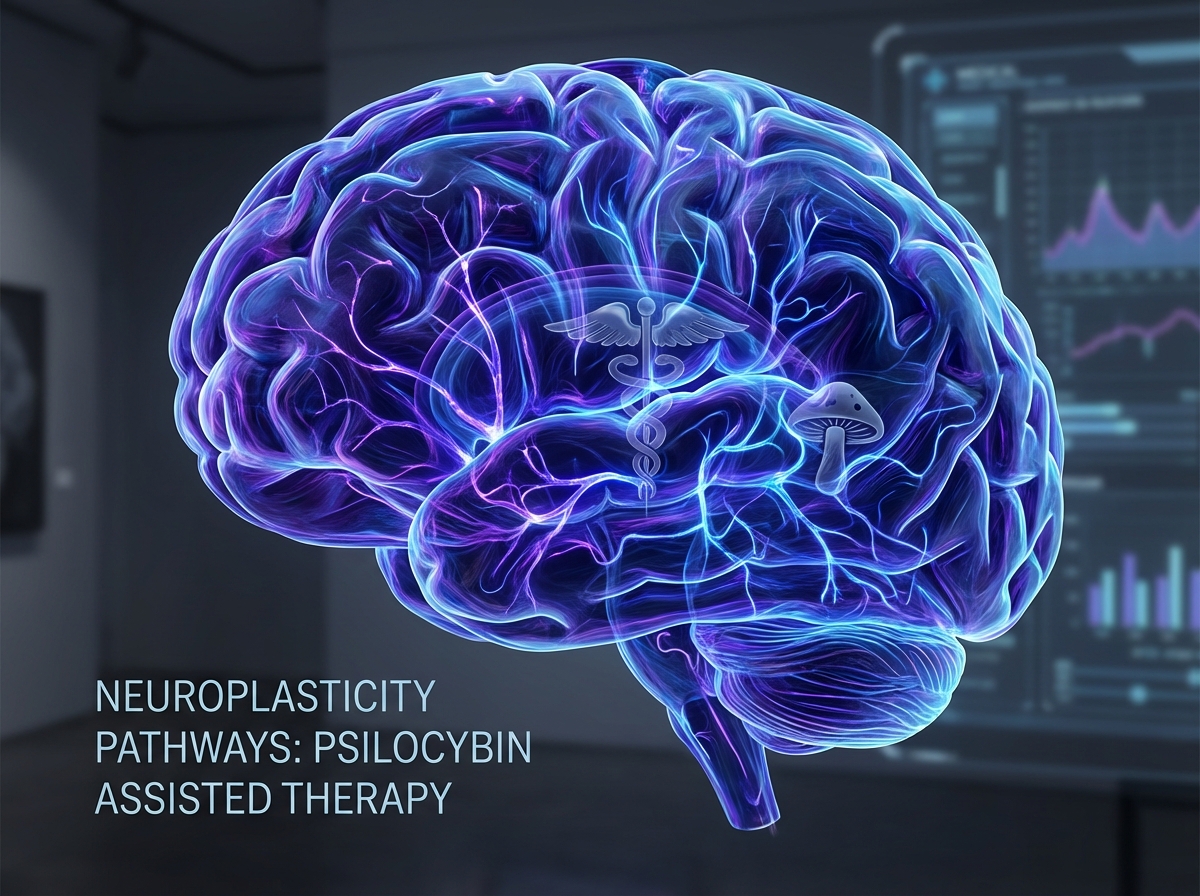
Psilocybin's Mechanisms in PTSD
DMN disruption and fear extinction: Psilocybin's suppression of the default mode network temporarily interrupts the rumination loops and memory-intrusion patterns that maintain PTSD symptoms. The disruption creates a window in which new associations can be formed and fear extinction can proceed more effectively.
Amygdala reactivity reduction: Research from Imperial College London and other groups shows that psilocybin reduces amygdala reactivity to threat-related stimuli. The hyperreactive threat-detection circuit in PTSD is directly attenuated by psilocybin's acute effects.
Neuroplasticity promotion: Psilocybin promotes BDNF and dendritic spine growth — the biological substrate for new learning. The neuroplasticity window following a session is hypothesized to make extinction learning during integration therapy more effective.
Memory reconsolidation: Psilocybin-assisted therapy may allow trauma memories to be retrieved and reprocessed during the reconsolidation window in a fundamentally different emotional context — one of safety, compassion, and expansive perspective rather than terror.
Veterans Research
The intersection of PTSD and veteran populations has driven some of the most significant recent research.
MAPS MDMA research (most advanced): The MAPS MDMA-PTSD trials, which included significant veteran populations, produced the most dramatic results in PTSD trial history before the FDA's 2024 rejection of the NDA (based on regulatory concerns rather than efficacy questions). Phase 3 data: 67% of participants in the MDMA group no longer met PTSD diagnostic criteria at follow-up vs. 32% for placebo.
Heroic Hearts Project: A veteran advocacy organization that has facilitated veteran access to legal psilocybin therapy in Jamaica and Oregon, and has collected observational data on outcomes. The data is preliminary but consistent with clinical trial findings.
VA research: Multiple Department of Veterans Affairs medical centers are now conducting or planning psilocybin and MDMA research for veteran PTSD. The 2026 executive order on psychedelic research accelerated VA involvement.
VETS Solutions (Veterans Exploring Treatment Solutions): Clinical trial network specifically recruiting veterans for psilocybin PTSD research.
Psilocybin vs. MDMA for PTSD
MDMA has more direct empirical support for PTSD than psilocybin does specifically. MDMA's prosocial and fear-reduction effects make it particularly suited to PTSD trauma processing — it reduces amygdala reactivity while maintaining memory access, creating an ideal pharmacological state for trauma processing.
Psilocybin's mechanism in PTSD is more indirect but potentially complementary — the depth of psychological processing and the lasting neuroplasticity effects may produce different benefits. Some clinicians theorize that psilocybin may be better suited to trauma that involves existential or meaning dimensions, while MDMA is better suited to relational trauma and specific fear-memory work.
The two are not substitutes — they complement each other. Some practitioners believe optimal PTSD treatment may eventually involve both, sequentially.
Access for Veterans in 2026
- Oregon service centers: Open to all adults 21+, including veterans
- Clinical trials: ClinicalTrials.gov has several veteran-specific psilocybin PTSD trials recruiting
- Heroic Hearts Project: facilitates veteran access to legal international retreat settings
- VA medical centers: Several now have active psychedelic research programs