Psilocybin Therapy for Veterans
A dedicated resource for veterans exploring psilocybin therapy — organizations, legal options, clinical trials, and the April 2026 Executive Order.
Psilocybin Therapy for Veterans
Veterans face mental health challenges at rates that significantly exceed the general population. An estimated 20–30% of combat veterans develop PTSD. Veteran suicide rates remain approximately 1.5 times higher than the general population, with little improvement over the past two decades despite significant investment in conventional treatment. Moral injury — guilt, shame, and grief over actions witnessed or participated in during service — is particularly resistant to standard therapeutic approaches.
Psilocybin therapy is not a cure. But for veterans who have cycled through multiple medications and years of conventional therapy without sustained relief, it represents a genuinely different mechanism — one that has produced dramatic results for some individuals and is now backed by a federal executive order directing accelerated research.
This page is a practical resource: organizations, legal options, clinical trial access, what the research shows, and what to expect.
The April 2026 Executive Order
On April 18, 2026, President Trump signed an executive order directing federal agencies to accelerate psychedelic research for veterans. The order specifically named psilocybin and ibogaine for PTSD and traumatic brain injury.
What the order does:
- Directs VA, DOD, HHS, and ONDCP to coordinate on removing bureaucratic barriers to clinical trial enrollment
- Instructs the VA to identify and fund clinical trial sites at VA medical centers
- Directs HHS to expedite review of research protocols involving psilocybin and ibogaine for veterans
- Creates a federal interagency working group to report on progress within 180 days
What the order does not do:
- It does not reschedule psilocybin or ibogaine (both remain Schedule I)
- It does not create legal access for veterans outside of clinical trials
- It does not authorize VA physicians to prescribe psychedelics
The practical effect: VA physicians can now more openly discuss clinical trial options with veteran patients. VA facilities are actively seeking trial partnerships. Congressional legislation (the VETERANS Act and companion bills) is being accelerated and has broader political support following the order.
Organizations Supporting Veterans
Heroic Hearts Project
The most active organization facilitating legal psilocybin therapy access for veterans in the United States. Founded by veteran Jesse Gould, Heroic Hearts provides:
- Facilitated access to legal service centers in Oregon and Colorado
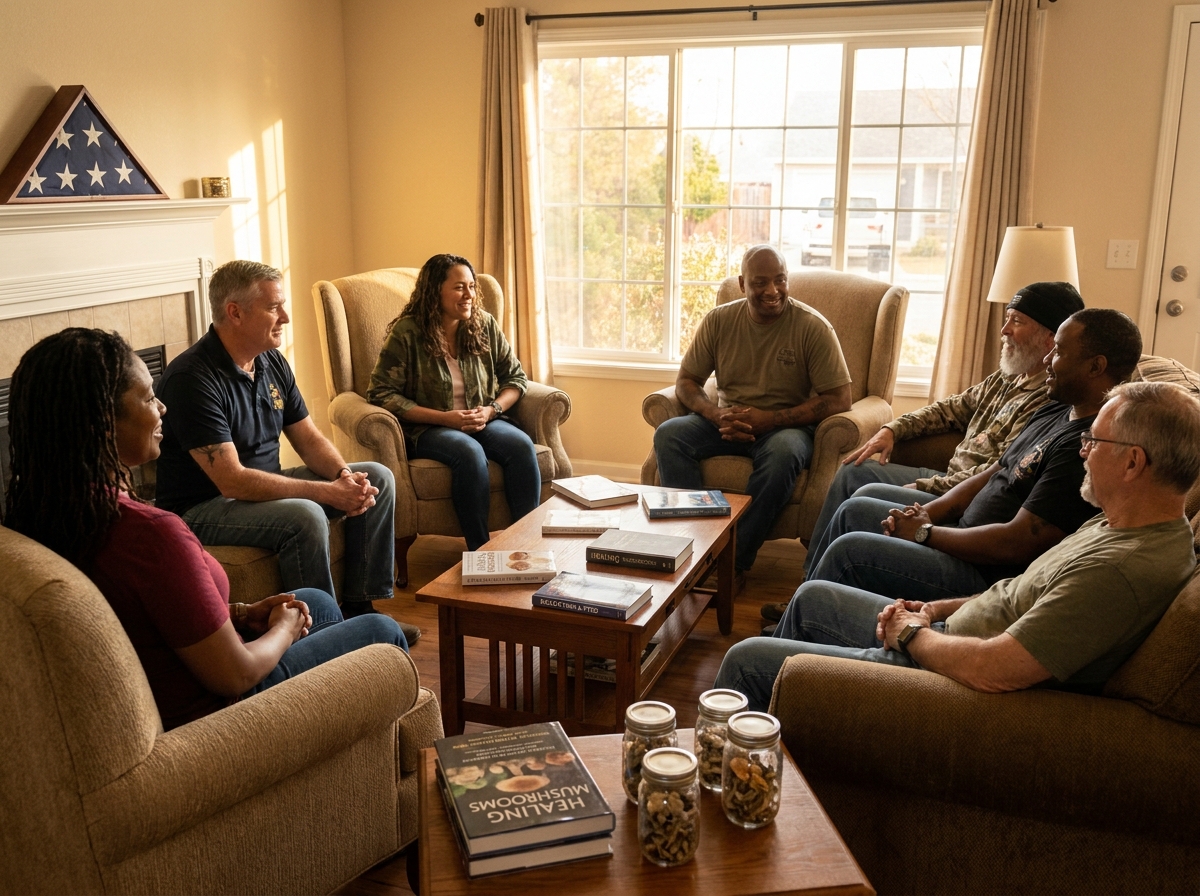
- Veteran-peer preparation and integration support from people who have gone through the process
- Scholarships and sliding-scale funding assistance
- Referrals to international programs (Jamaica, Netherlands) for veterans who cannot access US legal options
- A growing peer support network across all 50 states
Website: heroicheartsproject.org
Veterans of War
Advocacy and peer support organization focused on psychedelic therapy access for combat veterans. Provides policy advocacy, peer support networks, and connections to clinical trial enrollment.
MAPS (Multidisciplinary Association for Psychedelic Studies)
MAPS has run veteran-focused MDMA trials for PTSD since 2010 and is expanding to psilocybin research. Their clinical trial network includes sites specifically serving veterans.
Give Back Foundation
Provides financial assistance for veterans seeking legal psilocybin therapy in Oregon and Colorado, with a specific focus on veterans who cannot afford out-of-pocket session costs.
VA Whole Health Program
The VA's Whole Health initiative includes some integration of complementary approaches. Veterans enrolled in VA care can ask their provider about clinical trial participation through the VA's research division.
Legal Access Options in 2026
Oregon — Licensed Service Centers
Oregon's Measure 109 program allows adults 21+ to access psilocybin at licensed service centers without a diagnosis. Several Oregon service centers have specific experience with veterans:
- Trauma-informed facilitators with military cultural competency
- Veteran peer support during preparation and integration
- Sliding-scale pricing and veteran discounts at select centers
- Heroic Hearts Project can facilitate referrals to vetted Oregon providers
Cost: typically $800–$3,000+ for a full session package (preparation, session, integration). Some centers offer veteran scholarships.
Colorado — Healing Centers
Colorado's Prop 122 program allows licensed healing centers staffed by mental health professionals, enabling psilocybin to be integrated directly with psychotherapy. This model may be particularly suited to veterans with complex trauma because the therapeutic relationship can be maintained across sessions.
Colorado also uniquely allows personal adult possession and cultivation — veterans who have relocated to Colorado for other reasons may choose to self-administer in addition to, or instead of, licensed healing center sessions, though clinical guidance is strongly recommended.
Clinical Trials
Multiple VA-affiliated and university trials are actively enrolling veterans. This is the only free pathway to legal psilocybin in non-program states.
How to find enrolling trials:
- Visit ClinicalTrials.gov
- Search "psilocybin" and filter by condition (PTSD, depression, TBI)
- Filter by "Recruiting" status
- Many trials have veteran-specific eligibility criteria — read them carefully
The Heroic Hearts Project and Veterans of War can both help navigate the clinical trial landscape.
What Veterans Report
The qualitative accounts from veterans who have undergone psilocybin therapy are consistent enough across individuals that they constitute a meaningful signal, even before Phase 3 trials are complete:
Commonly reported outcomes:
- Reduction in hypervigilance and startle response
- Ability to sleep without recurrent nightmares (often for the first time in years)
- Reduced emotional numbing — reconnection with family and relationships
- Shift in relationship to traumatic memories — able to acknowledge them without being consumed
- Resolution of moral injury — not forgetting what happened, but releasing the weight of it
- Reduced alcohol and substance use following sessions
Commonly reported challenges:
- Difficult sessions with emotionally intense content — not everyone finds the experience immediately helpful
- Integration requires real work — insights from the session don't automatically translate into changed behavior
- Finding competent facilitators with genuine military cultural understanding is difficult in some regions
- Cost is a significant barrier for veterans without financial support
Ibogaine and TBI
While psilocybin gets more attention, ibogaine deserves specific mention for the veteran population. Ibogaine — derived from the African iboga plant — has shown particularly promising results for two conditions highly prevalent in combat veterans: opioid use disorder and traumatic brain injury.
A 2024 Stanford study of veterans who traveled to Mexico for ibogaine treatment showed dramatic reductions in PTSD symptoms, depression, anxiety, and disability ratings — results that have not been replicated by any conventional treatment. The April 2026 executive order explicitly included ibogaine alongside psilocybin, reflecting this evidence base.
Ibogaine carries significant cardiac risks and requires medical screening. It is not legal in the United States. Veterans seeking ibogaine treatment currently travel to Mexico, Jamaica, or Canada. Heroic Hearts Project has partnerships with vetted international ibogaine providers.
Preparing for a Session
Veterans considering psilocybin therapy should:
- Connect with peer support first — talking with veterans who have been through the process is the most valuable preparation. Heroic Hearts Project can connect you.
- Disclose all medications to your facilitator before booking — SSRIs, antipsychotics, and blood pressure medications all have relevant interactions (see drug interactions)
- Arrange integration support in advance — an integration therapist or peer support contact should be identified before the session, not after
- Plan time off — give yourself at least 3–5 days with no major commitments following a session
- Involve a trusted person — a spouse, family member, or close friend who knows what you're doing and can support your integration is valuable
See Set and Setting and What to Expect for detailed preparation guidance.
Getting Help Now
If you are a veteran in crisis, contact the Veterans Crisis Line: dial 988 and press 1, text 838255, or chat at veteranscrisisline.net. This line is staffed 24/7 by counselors with veteran experience.
Psilocybin therapy is not an emergency intervention. If you are in acute distress, please reach out to crisis support before pursuing any psychedelic therapy options.