
Trump's Psychedelic Executive Order: What Veterans Need to Know
In April 2026, President Trump signed an executive order directing federal agencies to accelerate work on psychedelic medicines for serious mental illness, with veterans and treatment-resistant conditions at the center of the announcement.
That is a real federal milestone. It is also easy to misunderstand. The order and the follow-up FDA and VA actions point toward more research, faster review, and more trial infrastructure. They do not make psilocybin legal nationwide, create a federal VA treatment entitlement, or replace the FDA approval process.
Quick Summary
What changed: The White House formally pushed federal agencies toward faster development and review of psychedelic medicines. FDA followed with actions involving psilocybin for depression, methylone for PTSD, and noribogaine research. VA announced a new MDMA-assisted therapy trial for veterans with PTSD and alcohol use disorder.
What did not change: Psilocybin, MDMA, methylone, ibogaine, and noribogaine are not broadly legal treatments for the public because of the executive order. Clinical use still depends on approved trials, FDA approval, state-regulated programs, or other lawful pathways.
Who should pay attention: Veterans, clinicians, policy watchers, Oregon/Colorado/New Mexico program participants, clinical-trial candidates, and anyone trying to separate research momentum from actual legal access.
The Federal Research Shift
The White House described the April 2026 order as an acceleration of research and access pathways for serious mental illness, especially for veterans. The announcement highlighted ibogaine, psychedelic drug development, Right to Try discussion, and the need for rigorous clinical trials.
This matters because federal agencies shape the research pipeline. VA sites, FDA review standards, HHS priorities, and clinical-trial infrastructure can all determine whether promising compounds move from early research into carefully regulated medical use.
But the practical lane is still research and drug development. It is not general legalization.
FDA Follow-Up: Psilocybin, Methylone, And Noribogaine
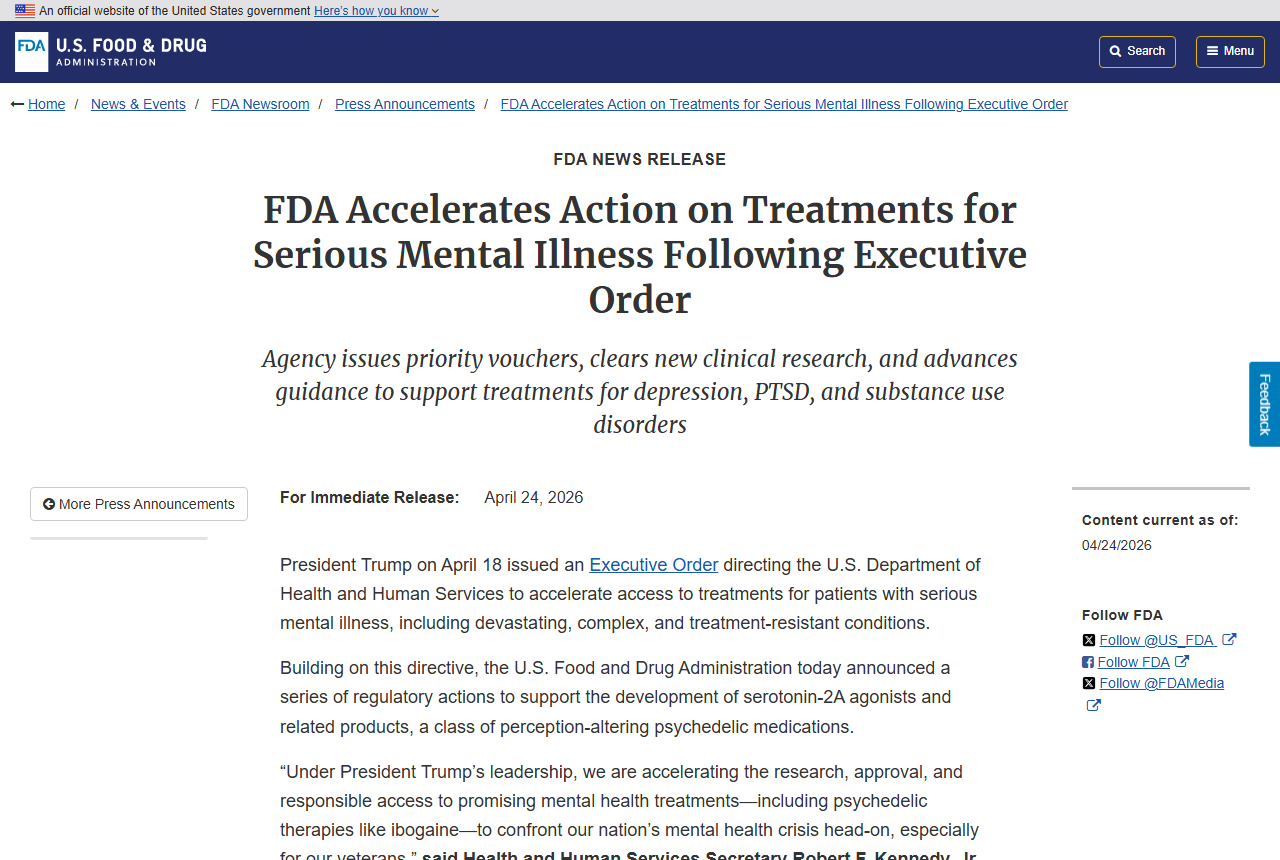
On April 24, 2026, FDA announced follow-up actions after the executive order. The agency said it would support development work for serotonin-2A agonists and related products for serious mental illness, including:
- Psilocybin for treatment-resistant depression.
- Psilocybin for major depressive disorder.
- Methylone for post-traumatic stress disorder.
- An early-phase clinical study of noribogaine hydrochloride for alcohol use disorder.
FDA also made the boundary clear: allowing a study to proceed is not the same as approving a drug or deciding it is safe and effective. That distinction is essential. A development program can be important and still be years away from ordinary clinical availability.

VA Follow-Up: A New MDMA Trial, Not Open Treatment
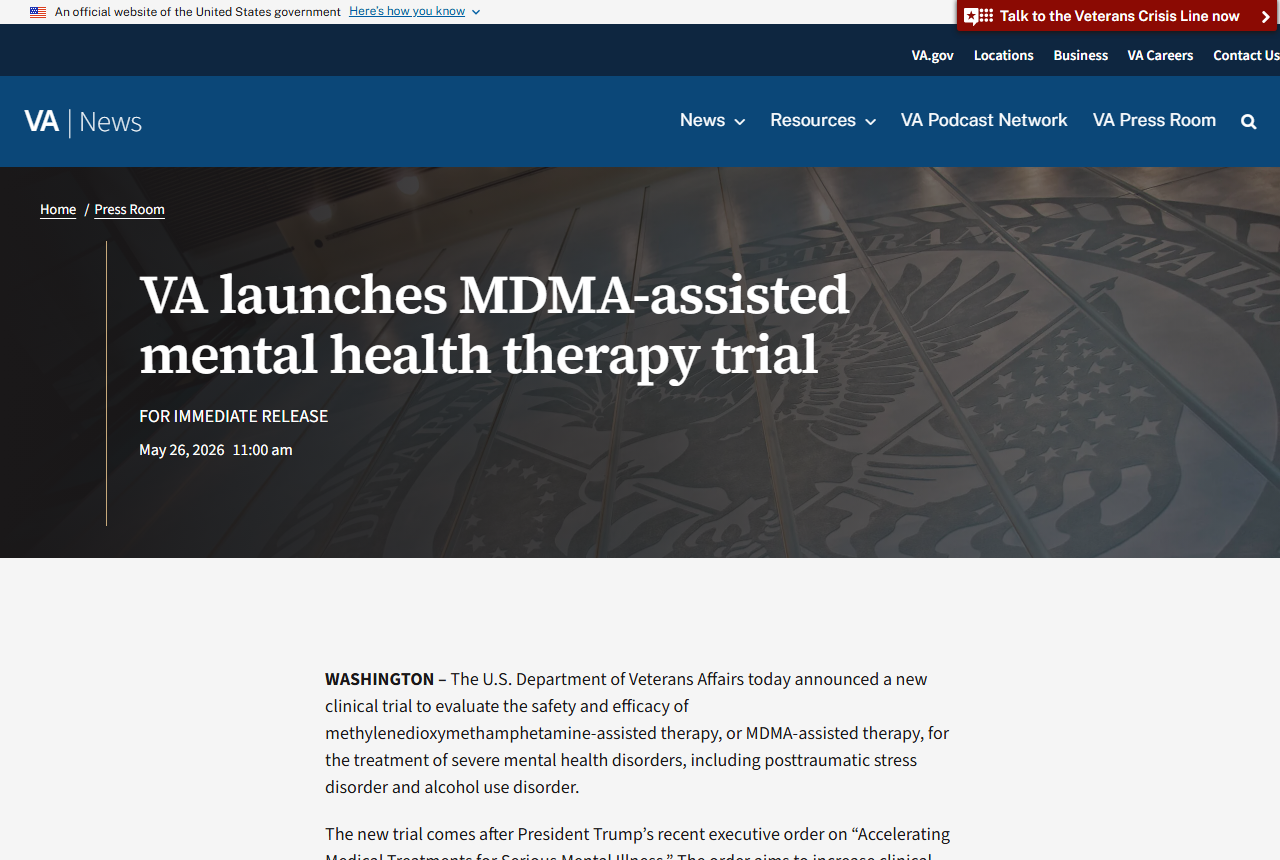
On May 26, 2026, VA announced a randomized controlled trial of MDMA-assisted therapy for veterans with PTSD and alcohol use disorder. VA also stated that it is involved in other psychedelic-therapy trials supported by external funding.
The same VA announcement included the sober line readers need: clinical use outside research will only be considered by VA once FDA approval is granted. VA also discourages self-medicating or replacing evidence-based care with unprescribed substances.
For veterans, the immediate path is clinical-trial screening and lawful state programs where available, not walking into a VA clinic and requesting psychedelic treatment.
What This Means For Psilocybin
Psilocybin is moving through multiple research lanes. The strongest federal signals in 2026 are around depression, serious mental illness, trial capacity, and eventual FDA review. Veterans matter here because PTSD, depression, alcohol use disorder, traumatic brain injury, and suicide risk are major federal health priorities.
The biggest mistake is treating "research acceleration" as "legal access." A compound can receive priority attention and still remain unavailable outside trials or state programs.
For now, psilocybin access in the United States still falls into separate buckets:
- FDA-regulated clinical trials for specific diagnoses and study criteria.
- State-regulated access such as Oregon and Colorado, with New Mexico building its medical program after its April 2025 law.
- Decriminalized jurisdictions where enforcement may be lower but commercial or medical use may still be illegal.
- General federal/state prohibition in many places.

Veterans, PTSD, And Clinical Trials
Veterans with PTSD have helped move this issue into serious policy discussions because many conventional treatments help some people and leave others still suffering. That does not mean psychedelic therapy is safe for everyone or proven for every veteran.
People with psychosis risk, bipolar I disorder risk, cardiovascular concerns, medication interactions, substance-use instability, or acute suicidality need careful medical screening. Trial protocols exist because the setting, preparation, monitoring, and follow-up matter.
If you are a veteran in crisis, call 988 and press 1, text 838255, or use the Veterans Crisis Line chat. Psychedelic research should never replace immediate crisis support.
What This Means / What It Does Not Mean
This means: federal psychedelic medicine research is now a visible national priority, especially for veterans and serious mental illness.
This means: FDA and VA activity may increase the number of lawful clinical-trial opportunities over time.
This does not mean: psilocybin is federally legal for public possession, home cultivation, sales, or unsupervised treatment.
This does not mean: VA is offering psychedelic therapy as routine care.
This does not mean: state law stopped mattering.
Source Links
- White House: April 2026 executive order announcement
- FDA: April 24, 2026 psychedelic development actions
- VA: May 26, 2026 MDMA-assisted mental health therapy trial
- FDA guidance: Psychedelic Drugs, Considerations for Clinical Investigations
- New Mexico Department of Health Medical Psilocybin Program FAQ