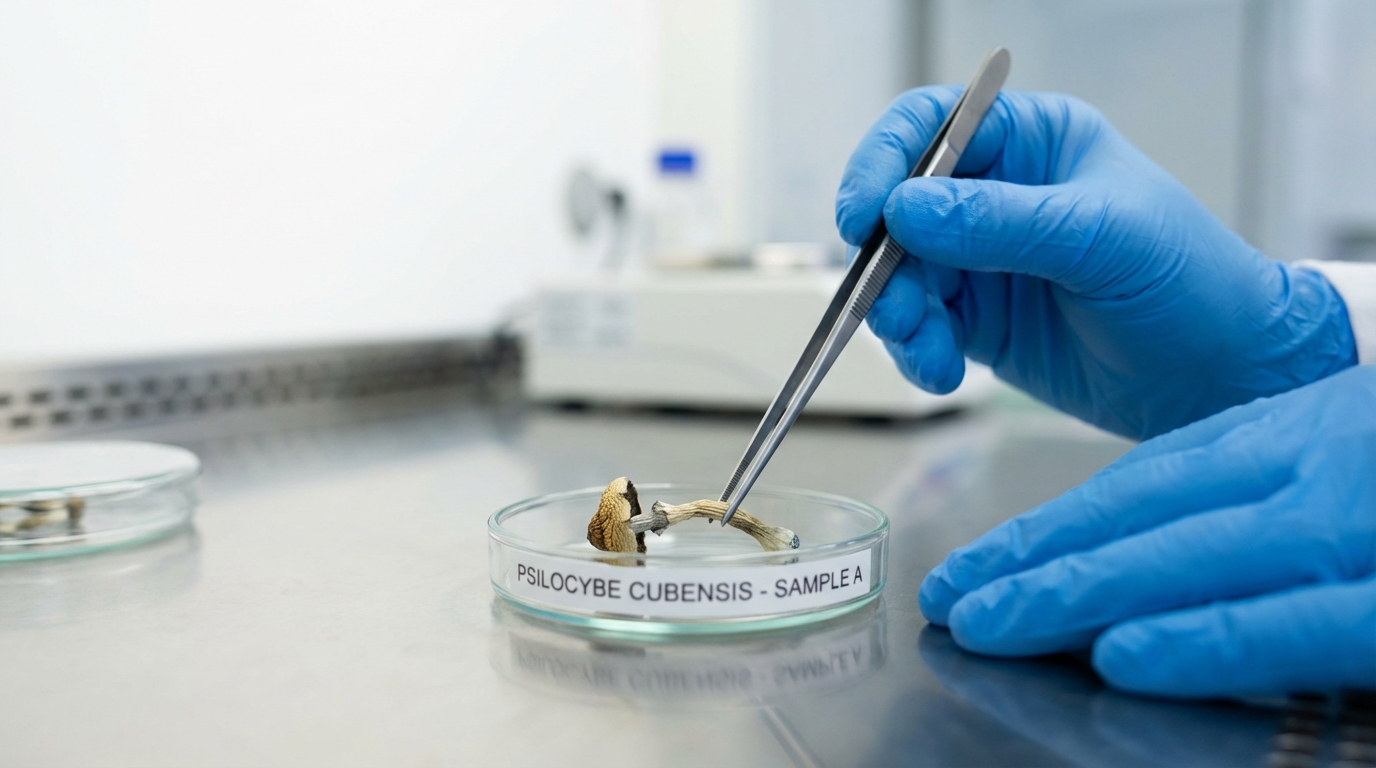
The Default Mode Network and Psilocybin: Why the Neuroscience Matters
The most compelling scientific explanation for why psilocybin works — for depression, addiction, OCD, and existential anxiety — comes from a cluster of brain imaging studies and a theoretical model called REBUS. Understanding it helps explain what the experience is actually doing and why the therapeutic protocol around it matters.
What Is the Default Mode Network?
The default mode network (DMN) is a set of interconnected brain regions that are most active when you're not focused on a specific task. It's the network that runs when you're daydreaming, ruminating, planning, remembering the past, or thinking about yourself in relation to others.
Key DMN regions include:
- Medial prefrontal cortex — self-referential thought
- Posterior cingulate cortex — self-reflection, autobiographical memory
- Hippocampus and parahippocampal gyrus — memory, navigation
- Angular gyrus — language, attention
The DMN is often described colloquially as the "narrator" — the part of the brain that tells the story of who you are, maintains consistent self-image, and generates the ongoing internal monologue.
The DMN in Depression, OCD, and Addiction
In several psychiatric conditions, DMN activity is dysregulated in specific ways:
Major depression: Hyperactivity of self-referential DMN processing, particularly in the medial prefrontal cortex. Depressed patients ruminate — their inner narrator loops on self-critical, negative self-referential content with excessive persistence. The hierarchy of thought becomes rigid, stuck.
OCD: The DMN maintains intrusive thoughts and compulsive patterns with unusual tenacity. The error-signaling systems are overactive; the brain treats normal uncertainty as threat and responds compulsively.
Addiction: The DMN maintains elaborate self-concepts organized around drug use and the behaviors that sustain it. Identity is entangled with the substance. The predictive machinery that keeps behavior stable is running in service of the addiction.
In each case, the underlying mechanism is similar: the brain's hierarchical prediction system — which maintains beliefs about self and world — has become overconfident, stuck in a loop, resistant to updating.
REBUS: The Theoretical Model
REBUS stands for Relaxed Beliefs Under Psychedelics (or sometimes the full REBUS and the Anarchic Brain model). It was proposed by Robin Carhart-Harris and Karl Friston in 2019 and draws on active inference and predictive processing theories of brain function.
The core claim of REBUS:
The brain operates as a hierarchical predictive system — high-level beliefs and priors (expectations about self and world) constrain what lower-level sensory information can influence. In depression, OCD, and addiction, these high-level priors become overly rigid. The brain's confidence in its own narrative prevents new information from changing the system.
Psilocybin, acting primarily on 5-HT2A serotonin receptors concentrated in the cortex's higher layers, temporarily flattens this hierarchy. The high-level priors relax their grip. Lower-level, more sensory and bottom-up processing temporarily gains influence over experience.
The result: a period in which the brain's settled, self-perpetuating narratives are more open to revision. Old patterns have less grip. New patterns can form.
What This Looks Like in Brain Imaging
The imaging data is striking:
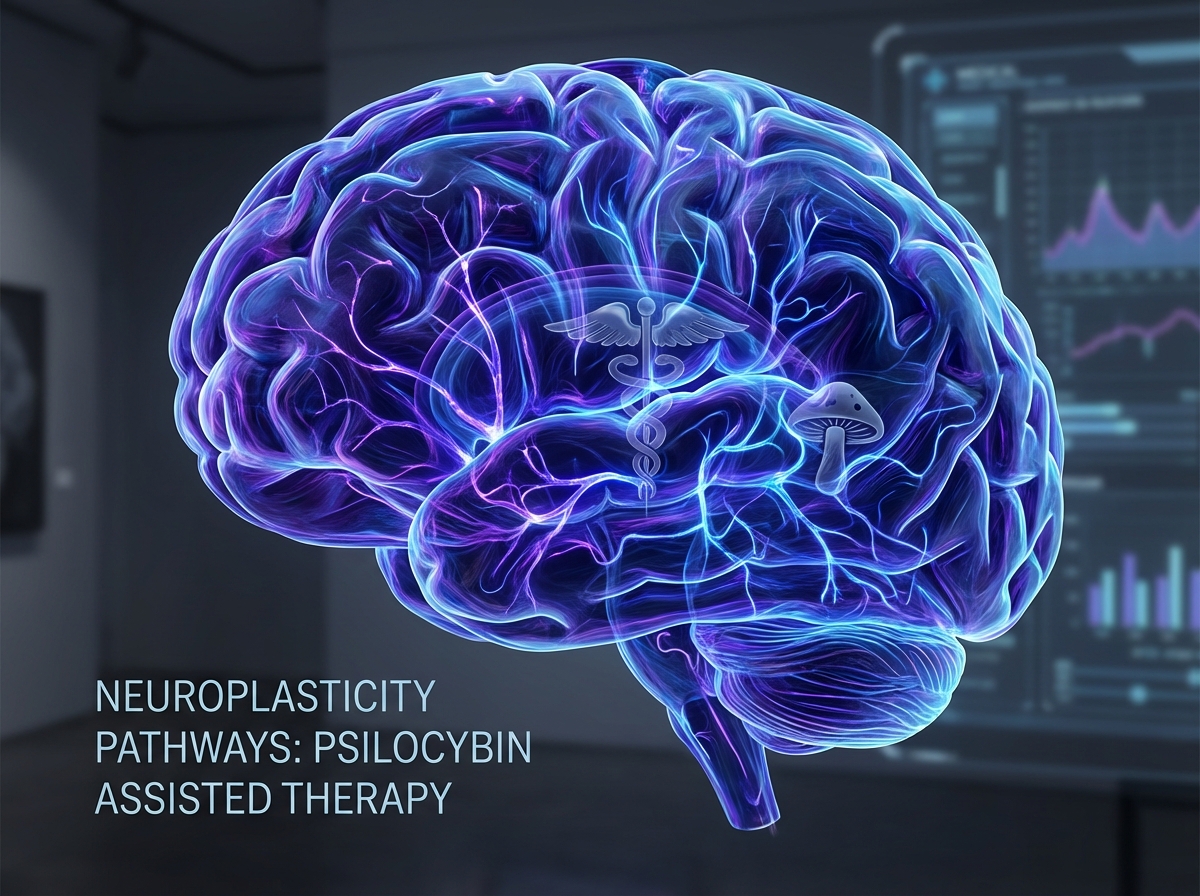
DMN suppression: Psilocybin reliably reduces connectivity and activity within the DMN, including self-referential processing regions. This is measurable by fMRI during a session.
Increased cross-network connectivity: Areas that don't normally communicate freely do so under psilocybin — the visual cortex connects with language areas, the DMN connects with task-positive networks. This increased "entropy" in brain connectivity corresponds to the subjective feeling of loosened boundaries and atypical perception.
Network dissolution: At high doses, distinct brain networks temporarily lose their boundaries. The sense of a unified self (which depends on stable DMN functioning) can dissolve. This is the neurological correlate of what's described as ego dissolution.
Post-session changes: Studies (particularly Imperial College London and Johns Hopkins) show measurable increases in DMN flexibility and decreased rigidity in the weeks after psilocybin — particularly in people who showed treatment response.
Neuroplasticity: The Window After the Session
Psilocybin also drives post-session neuroplasticity through a separate mechanism:
- 5-HT2A agonism triggers rapid BDNF (Brain-Derived Neurotrophic Factor) expression
- BDNF elevation supports dendritic growth — literally new synaptic connections
- This elevated neuroplasticity persists for approximately 2-4 weeks post-session
This is why the therapeutic protocol around the session matters as much as the session itself. The weeks following psilocybin administration are a biologically special window in which:
- New cognitive patterns are easier to form
- Behavioral change has unusual traction
- Therapeutic work has more leverage
The clinical protocols that produce the best outcomes — intensive CBT for addiction, ERP for OCD, integration therapy for depression — concentrate this work in the post-session plasticity window deliberately.
Why Therapy Plus Psilocybin Outperforms Psilocybin Alone
The mechanism explains the clinical finding: psilocybin with therapy consistently outperforms psilocybin without therapy (and therapy alone without psilocybin).
The session creates the opening — the REBUS effect relaxes the stuck hierarchical patterns. But the opening alone doesn't mean new, healthier patterns will form. Therapeutic work in the session (preparation, facilitation, integration) provides the direction in which that reopened plasticity develops.
Without this therapeutic context, the neural opening may resolve back to prior patterns, or develop in unintended ways. This is why most researchers and clinicians are skeptical of psilocybin as a pure pharmacological treatment — the mechanism predicts that context matters enormously, and the data confirms it.
The Mystical Experience Correlation
One of the most consistent findings across psilocybin trials is that outcomes correlate with mystical-type experience intensity — the degree to which participants reported the session as feeling deeply meaningful, unified, transcendent, and beyond ordinary language.
The REBUS model provides one mechanistic hypothesis for this correlation: the highest degrees of DMN suppression and network dissolution produce the most profound experiences, and these same states may also produce the deepest disruption of the maladaptive priors driving the condition being treated.
This doesn't require any particular metaphysical interpretation of the mystical experience. It simply suggests that the depth of the neural disruption correlates with the depth of the therapeutic effect.
Where the Science Is Heading
The REBUS model is influential but not settled. Open questions:
- What drives variation in response? Not everyone who has a high-intensity mystical experience responds therapeutically. What predicts who does?
- How does the post-session window close? What determines when neuroplasticity returns to baseline — and can interventions extend the window?
- Beyond DMN: Other mechanisms (serotonin system, neuroinflammation, glutamate) are also being investigated. The DMN story may be necessary but not sufficient.
- Different conditions, different mechanisms? Depression, addiction, OCD, and cancer anxiety may involve the same REBUS mechanism differently expressed. Personalized protocols may be important.
Resources
- Carhart-Harris, R., & Friston, K. (2019). REBUS and the anarchic brain: toward a unified model of the brain action of psychedelics. Pharmacological Reviews, 71(3), 316-344.
- Carhart-Harris, R. et al. (2012). Neural correlates of the psychedelic state as determined by fMRI studies with psilocybin. PNAS.
- Barrett, F.S., et al. (2020). Psilocybin-induced changes in brain network functional connectivity. Psychopharmacology.
- Psychedelic Alpha: psychedelicalpha.com — science tracking
- Hopkins Psychedelics: hopkinspsychedelic.org — ongoing research updates