
Why Researchers Had to Define "Mystical Experience"
The idea that a drug-induced state could produce a genuinely mystical experience was considered scientifically disreputable for decades. The concept seemed irreducibly subjective — too vague to measure, too culturally loaded to operationalize. That changed beginning in the 1960s, when Walter Pahnke's "Good Friday Experiment" at Boston University demonstrated that psilocybin could reliably induce experiences that subjects described, in retrospect, as among the most meaningful of their lives.
Pahnke developed the first structured questionnaire for assessing these states, drawing on philosopher Walter Stace's taxonomy of mystical experience from religious and philosophical literature. Stace identified common features across cultures and traditions: unity with all things, noetic quality (the sense that knowledge has been directly revealed), transcendence of time and space, deep sense of sacredness, and ineffability. Pahnke's questionnaire operationalized these into scorable items.
That questionnaire has since been refined into two primary instruments used in modern clinical research.
The Mystical Experience Questionnaire (MEQ30)
The MEQ30 is the most widely used tool in current psilocybin research. It contains 30 items rated on a six-point scale, asking participants to describe their experience within the first 24 hours following a session. The questionnaire covers four subscales:
Mystical: Sense of unity, sacredness, deeply felt positive mood, transcendence of time and space, and ineffability (difficulty expressing the experience in words).
Positive mood: Feelings of joy, peace, awe, and love during the session.
Transcendence of time and space: The experience of being outside ordinary temporal and spatial constraints.
Ineffability and paradoxicality: The sense that the experience defied ordinary language and contained apparent contradictions that nevertheless felt resolved.
A "complete mystical experience" is defined as scoring above 60 percent on all four subscales simultaneously. This threshold matters because research has consistently found that complete mystical experiences predict therapeutic outcomes more strongly than partial ones.

The Mystical Experience Scale (MES)
The MES, developed by Ralph Hood at the University of Tennessee, takes a different approach — it is longer (32 items) and draws more directly on Stace's philosophical framework. It distinguishes between extrovertive mysticism (unity experienced through the external world) and introvertive mysticism (pure consciousness without content).
The MES is used less commonly than the MEQ30 in clinical trials but remains influential in psychedelic research focused on the nature of the experience itself rather than clinical outcomes.
What the Research Linking Mystical Experience to Outcomes Shows
The predictive relationship between mystical experience and therapeutic benefit is one of the most replicated findings in psychedelic research:
Depression: In the Johns Hopkins and Imperial College London trials for major depression and treatment-resistant depression, mystical experience scores on the MEQ30 predicted symptom reduction at follow-up. Participants who scored above the complete mystical experience threshold showed larger and more durable antidepressant effects.
Smoking cessation: Matthew Johnson's Johns Hopkins trial found that MEQ30 scores on the psilocybin session day were the single strongest predictor of abstinence at six months — stronger than any demographic variable or pre-treatment characteristic.
Alcohol use disorder: The NYU Bogenschutz trial found that mystical experience scores correlated with reductions in heavy drinking days at follow-up, with higher scores associated with greater reductions.
End-of-life anxiety: Both the NYU Grob and Johns Hopkins Ross trials for cancer-related existential distress found that mystical experience intensity predicted reductions in anxiety and depression at follow-up.
The Causation Problem
The correlation between mystical experience and outcomes does not establish causation. Several alternative explanations exist:
Personality and expectancy: Participants who are psychologically open, well-prepared, and who expect a positive outcome may be more likely to have a mystical experience and also more likely to benefit — not because the experience caused the benefit, but because a third variable predicts both.
Dose confound: Higher doses produce both stronger mystical experiences and stronger pharmacological effects. It is possible that dose is the real predictor, and the mystical experience is simply a marker of adequate dosing.
Setting effects: Participants in warm, well-supported environments may have more profound experiences and also recover better — again with environment as a confounding variable.
Researchers have attempted to control for these factors with varying success. The finding remains robust across studies and across research groups, but the mechanism by which mystical experience drives outcomes — if it does — remains an active area of inquiry.
What This Means for Practitioners
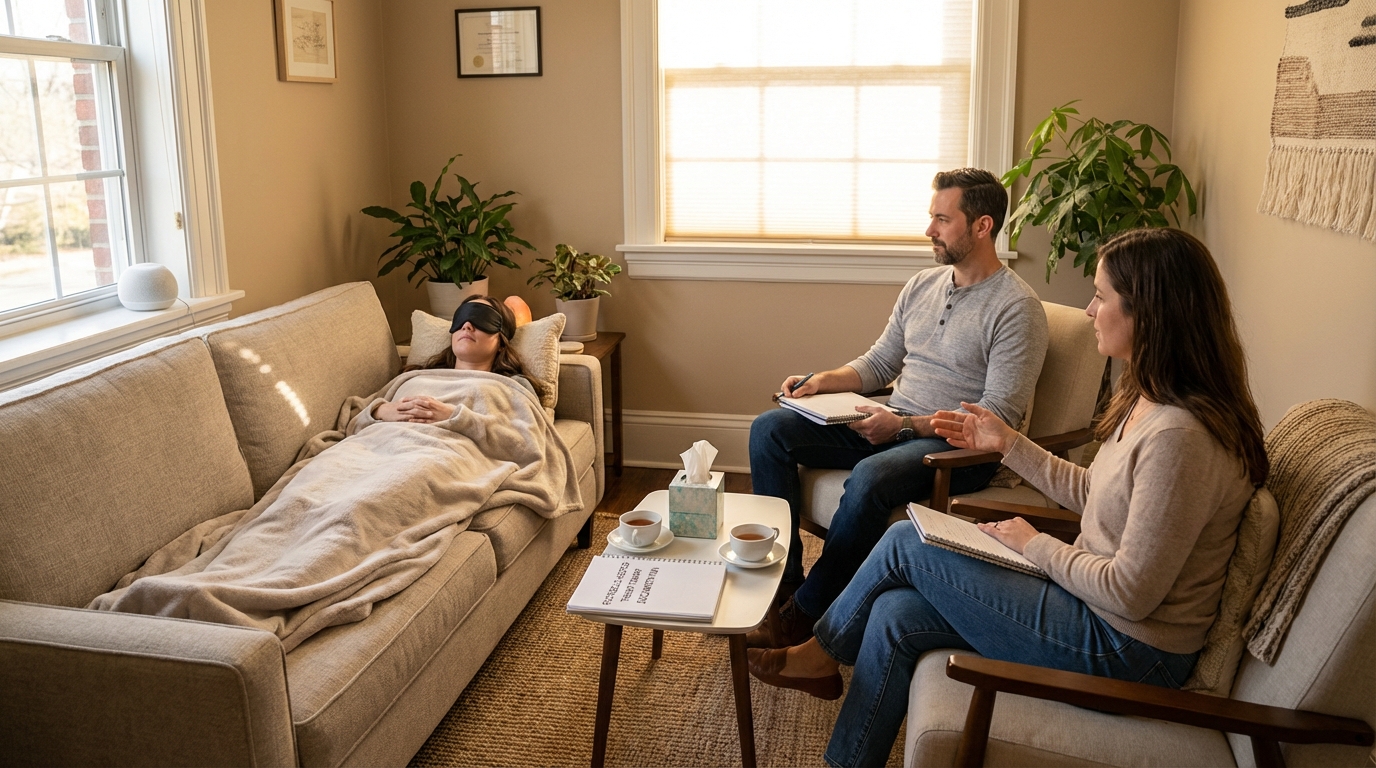
Understanding the role of mystical experience in psychedelic therapy has influenced how sessions are designed. The high-dose protocols common in clinical trials (25 mg/70 kg or higher) are calibrated to produce complete mystical experiences in most participants. Music playlists used during sessions are selected to support an inward, emotionally engaged journey rather than a pleasant background experience. Eye shades are used to encourage internal focus.
Facilitators trained in the Johns Hopkins or NYU models are taught not to interpret or direct the experience but to hold space — to be present without interfering with the arc of whatever arises. This non-directive approach is partly a product of understanding that the experience itself, in its full intensity, appears to be a key ingredient in the outcome.
The mystical experience questionnaire has also influenced integration work. Therapists helping clients process their sessions often ask explicitly about the features measured by the MEQ30 — the sense of unity, the noetic quality, the emotional valence — because understanding how the client experienced the session informs how they might integrate it meaningfully into their ongoing life.