Substrate Guide
Everything you need to know about Substrate Guide — from materials to first harvest.
What You'll Need
- See full supply list in guide below.
Find grow supplies at vendors in our Directory.
Step-by-Step Process
Substrate Guide: Choosing and Preparing Growing Media
Substrate is the nutritional foundation your mycelium colonizes and fruits from. Choosing the right substrate — and preparing it correctly — is one of the most impactful variables in cultivation. The same strain, same technique, and same conditions can produce dramatically different yields depending on substrate selection and preparation quality.
This guide covers the most common substrates for Psilocybe cubensis cultivation: what they are, how to prepare them, which strains and techniques they suit, and how to combine them effectively.
The Two Substrate Roles
Understanding how substrates are used helps clarify why different materials are chosen for different purposes.
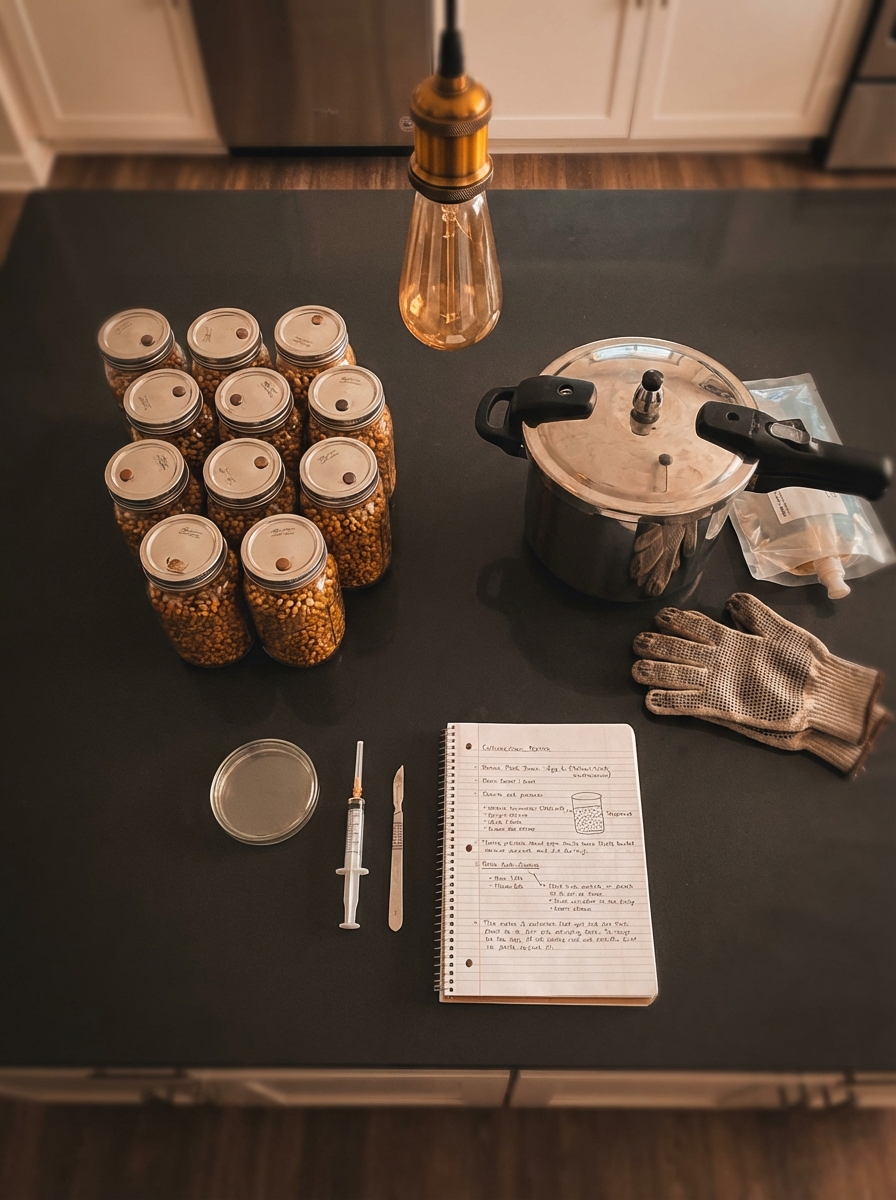
Spawn substrate: The initial substrate that grain or BRF is sterilized in and mycelium first colonizes. Grain (rye, oat groats, wheat berries) is the most common spawn substrate for bulk grows. BRF is spawn substrate in PF Tek. Spawn is typically sterilized at 15 PSI in a pressure cooker.
Bulk substrate: The larger volume of material that colonized spawn is mixed into for the main fruiting mass. CVG, straw, manure blends, and wood-based mixes are all bulk substrates. Bulk substrate is typically pasteurized (not pressure cooked) before use.
Most monotub grows use both: grain spawn (sterilized) inoculated into bulk substrate (pasteurized).
Grain Spawn Substrates
Grain spawn is the standard vehicle for carrying mycelium from inoculation to bulk grows. It colonizes quickly, provides high inoculant density, and produces vigorous mycelium.
Rye Berries
The most popular grain for spawn. Rye has an ideal nutrient profile for cubensis mycelium — high in complex carbohydrates and protein relative to competing organism risk. It colonizes faster than most alternatives and produces dense, vigorous mycelium.
Preparation:
- Rinse rye berries thoroughly until water runs clear.
- Simmer in water for 15–20 minutes until berries are hydrated but not bursting (skins intact). Do not boil hard — burst grain creates a wet, starchy mess prone to contamination.
- Drain and spread on a towel or wire rack to surface-dry for 30–60 minutes. Grain should be moist but no visible water droplets on the surface.
- Fill mason jars approximately 2/3 full. Leave headspace for gas exchange.
- Cap with polyfill-stuffed lids (same as BRF jars).
- Pressure cook at 15 PSI for 90 minutes. Allow to cool fully before inoculation.
Field capacity check: After cooling, shake a jar. Grain should move freely — no clumping. If it clumps in a wet mass, your grain was over-hydrated; contamination risk is high.
Oat Groats (Whole Oats)
A reliable alternative to rye that many growers prefer for being slightly more forgiving of over-hydration. Colonization speed is similar to rye. Slightly lower nutrient density means slightly lower contamination risk.
Preparation is identical to rye berries.
Wheat Berries
Good performance, similar to oat groats. More widely available in some regions. Preparation identical.
Popcorn
Cheap, widely available, and effective. The tough outer hull of popcorn kernels makes it less prone to waterlogging than rye. Slightly slower colonization than rye. Preparation: same as rye but simmer 10–15 minutes (the hull limits water absorption).
Wild Bird Seed (WBS)
A mix of millet, milo, sunflower seed, and other small grains. Very popular because it's inexpensive and widely available. The seed mix variety means different seeds colonize at different rates — produces a somewhat less uniform result than single-grain spawn but works well. Preparation: rinse, simmer 10 minutes, surface-dry, sterilize.
Bulk Substrates
Bulk substrate is where the fruiting mass lives. Volume matters: more bulk substrate equals more total mycelium equals more potential yield.
CVG (Coco Coir + Vermiculite + Gypsum)
The most widely used bulk substrate for indoor cubensis cultivation. CVG is popular for good reason:
- Pasteurizable — boiling water is sufficient; no pressure cooker needed for bulk substrate preparation
- Contamination-resistant — coco coir's lignin content and low nutrient density make it hostile to most competing organisms while supporting cubensis mycelium
- Moisture-retentive — fine vermiculite holds water and slowly releases it, maintaining humidity at the substrate level
- Inexpensive — coco coir bricks are cheap; vermiculite is cheap; gypsum is cheap
Standard recipe:
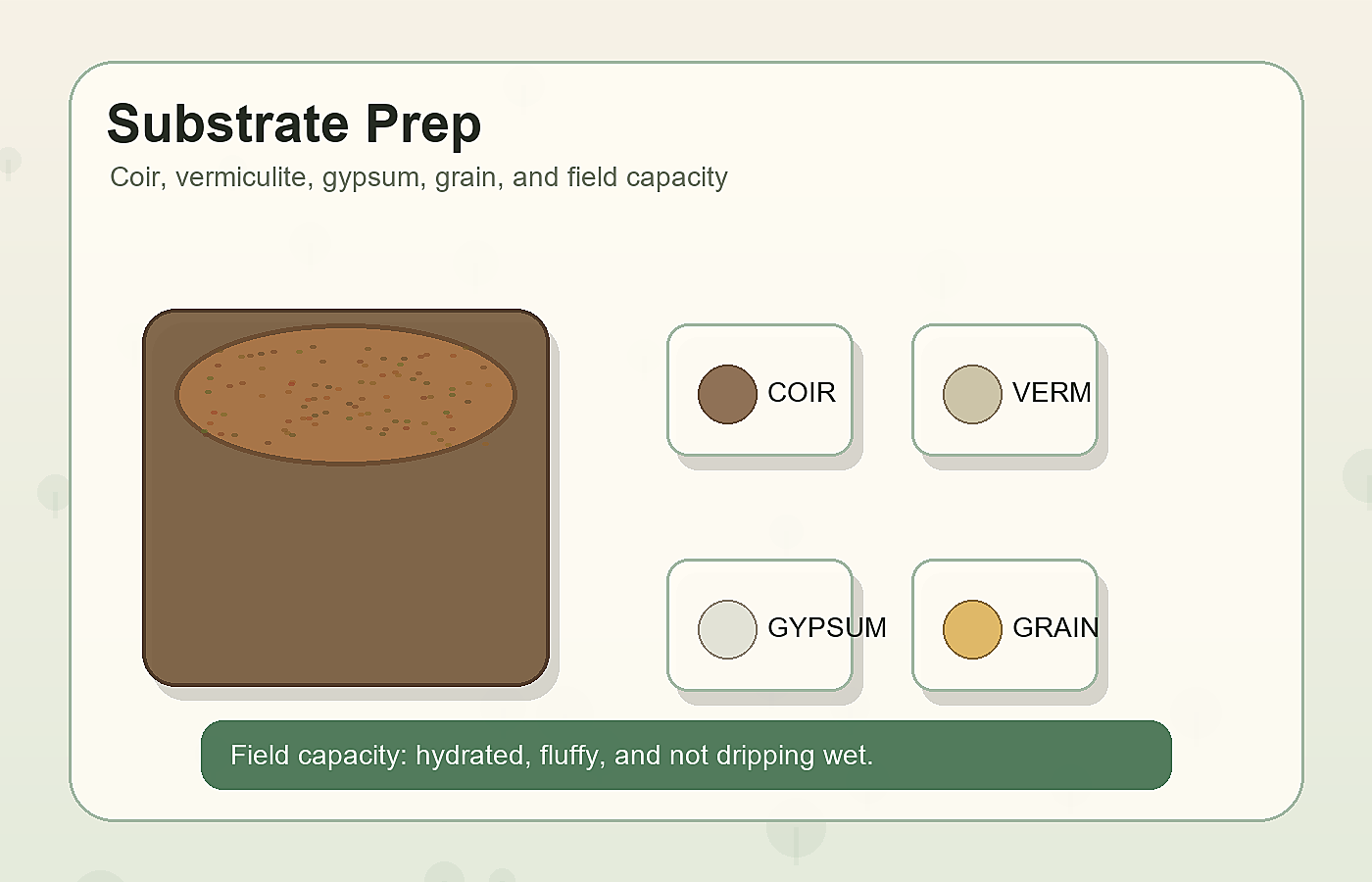
| Ingredient | Amount | |-----------|--------| | Coco coir (compressed brick, dry weight) | 650g | | Fine vermiculite | 2 liters | | Gypsum (food-grade) | 1 cup | | Boiling water | 4.5–5 liters |
Preparation:
- Break up coco coir brick into a large bucket.
- Pour boiling water over coir. Add vermiculite and gypsum. Mix thoroughly.
- Cover and allow to cool to room temperature (8+ hours). The covered cooling is a form of pasteurization — extended heat kills most competing organisms.
- Verify field capacity before use (see monotub guide).
CVG suits all beginner and intermediate cubensis strains. It is the default recommendation unless you have specific reasons to use an alternative.
Pasteurized Manure
Horse or cow manure — partially composted and pasteurized — is the natural substrate of wild Psilocybe cubensis. It produces the best yields for most strains if prepared correctly.
Manure-based substrates have a higher nutrient content than CVG, which means:
- Higher potential yields
- Higher contamination risk (more nutrients also feed competing organisms)
- Requires more careful pasteurization
What to use: Horse manure (partially composted, not fresh) is most common. Dried horse manure pellets sold as garden amendment are convenient and widely available — simply add water and pasteurize. Cow manure works similarly.
Preparation:
- Hydrate dried manure pellets with water to field capacity.
- Combine with pasteurized straw (see below) or coco coir in a 1:1 ratio to improve structure and reduce contamination risk. Pure manure substrate can be too compact and wet.
- Pasteurize: heat to 160–180°F (70–82°C) and hold for 1–2 hours. A large pot on the stove, an oven at 170°F, or a pasteurization bag (pour near-boiling water over substrate in a sealed bag) all work.
- Cool to room temperature before use.
Manure-based grows produce larger, denser fruiting bodies in many strains. It is particularly well-suited for B+, Amazonian, and Treasure Coast. Not recommended for beginners due to contamination management complexity.
Pasteurized Straw
Wheat or oat straw provides a high-carbon, lower-nutrient bulk substrate that works well as a component in blends. Pure straw is less common for cubensis than for oyster mushrooms (which prefer it); blending straw with manure or coco coir gives the best of both.
Preparation:
- Chop straw into 2–4 inch pieces. Smaller pieces colonize faster and pack better.
- Pasteurize: submerge in 160°F water and hold for 1–1.5 hours, or pour boiling water over chopped straw in a sealed plastic bag, seal, and allow to cool.
- Drain thoroughly. Straw should be moist but not dripping.
Use: Mix pasteurized straw 1:1 with pasteurized manure for a well-rounded bulk substrate. Some growers use straw as a CVG supplement (30–40% straw to 60–70% CVG) for improved structure.
Vermiculite
Vermiculite alone is not a nutritious substrate — it has no food value for mycelium. Its role is structural and moisture-related:
- As a component of CVG: holds water and creates air pockets
- As a dry casing layer on BRF PF Tek cakes: contamination barrier
- Mixed into any substrate: improves moisture distribution and aeration
Do not use vermiculite as a primary substrate. Always combine with a nutritional component.
Masters Mix
Masters Mix is a 1:1 blend of hardwood fuel pellets (HWFP) and wheat bran by dry weight. It is the highest-yield bulk substrate for many gourmet mushroom species (oysters, lion's mane, shiitake) and is used by some cultivators for cubensis — primarily with more wood-adapted strains.
For cubensis: Masters Mix requires pressure sterilization (not just pasteurization) due to its high nutrient content. Contamination risk is significantly higher than CVG or manure-based substrates. It is not the recommended starting point for cubensis bulk substrate work.
Substrate Comparison
| Substrate | Preparation | Contamination Risk | Yield Potential | Best For | |-----------|------------|-------------------|-----------------|----------| | BRF (PF Tek) | Sterilize | Low-medium | Low (by design) | Beginners | | Rye grain | Sterilize | Medium | High (spawn) | Spawn only | | CVG | Pasteurize | Low | Medium-high | Most cubensis grows | | Pasteurized manure | Pasteurize | Medium-high | High | Experienced growers | | Manure + straw blend | Pasteurize | Medium | High | Experienced growers | | Masters Mix | Sterilize | High | Very high | Advanced only |
Field Capacity: The Most Important Variable
Regardless of substrate type, field capacity is the single most important preparation variable. Substrate that is too wet becomes anaerobic, promotes bacterial contamination, and produces stalled or absent fruiting. Substrate that is too dry stalls mycelium growth and reduces yield.
The squeeze test: Take a handful of prepared substrate and squeeze firmly.
- Correct: 1–5 drops drip from your fist; substrate holds shape when released
- Too wet: water streams freely from your fist
- Too dry: substrate crumbles; no water expressed
Correcting over-wet substrate: mix in dry vermiculite (for CVG-based substrates) or dry coco coir. Re-test.
Correcting under-hydrated substrate: add small amounts of water, mix thoroughly, re-test.
Substrate Sterilization vs. Pasteurization
Sterilization (pressure cooking at 15 PSI for 60–120 minutes): Kills all living organisms including bacterial endospores. Required for grain spawn. Required for any high-nutrient substrate (Masters Mix). Not practical for large volumes.
Pasteurization (heating to 160–180°F for 1–2 hours): Kills most vegetative organisms but not heat-resistant bacterial endospores. Sufficient for bulk substrates because the endospores that survive pasteurization are generally slow-growing and are outcompeted by rapidly colonizing cubensis mycelium — particularly at high spawn ratios.
Why not sterilize bulk substrate? Large volumes of bulk substrate are impractical to sterilize effectively in most home setups. Pasteurization is faster, requires less equipment, and produces reliable results for CVG and manure-based substrates. The contamination risk with pasteurized bulk substrate is managed by using vigorous spawn at an appropriate ratio (1:3 to 1:4).
Supplementation
Adding nitrogen-rich amendments to bulk substrate increases yield but also increases contamination risk. Common supplements:
Gypsum: Not a true nutritional supplement but improves substrate structure and provides calcium and sulfur. Low contamination risk. Recommended at 1 cup per 650g coir brick in CVG.
Coffee grounds: Used, fully spent grounds (not fresh) add nitrogen. Mix 10–20% into CVG bulk substrate. Higher percentages significantly increase contamination risk. Pasteurize the combined mixture after adding.
Bran (wheat or oat): Adds protein and starch. Used in small amounts (5–10% of substrate volume) to boost CVG. Higher percentages require sterilization, not pasteurization.
The general rule: beginners should avoid supplementation until they can consistently produce clean, fully colonized tubs with unsupplemented substrate. Once contamination control is mastered, supplementation becomes a yield tool rather than a liability.
Casing Layers
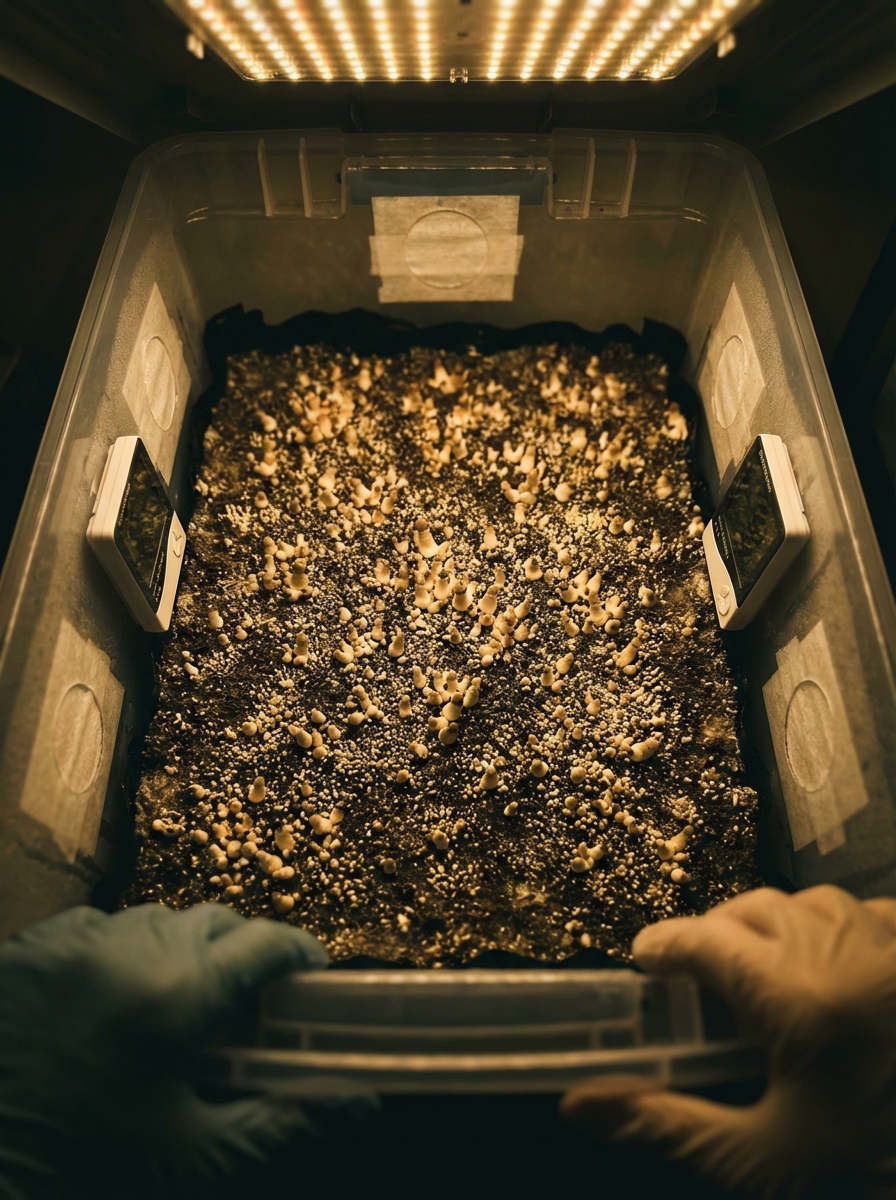
A casing layer is a thin layer of material applied to the surface of fully colonized bulk substrate before fruiting. It is not required for cubensis in standard monotub grows — bare CVG fruits well without casing — but some growers use it to improve pin distribution, moisture retention, and consistency.
Common casing materials:
- Coco coir + vermiculite (50/50): The simplest casing; improves surface humidity retention
- Peat moss + hydrated lime: Classic "LP casing" (lime-perlite); raises pH to inhibit contamination at the surface
- Field capacity peat alone: Simple and effective; widely used in professional gourmet production
When to case:
- If your substrate surface dries out between fanning sessions
- If pinning is sparse or concentrated in corners rather than distributed
- If you are working with a slow-pinning strain
Apply casing at 1/4 to 1/2 inch depth over fully colonized substrate surface. Allow casing to colonize partially (4–7 days) before introducing fruiting conditions.
Common Problems & Troubleshooting
See the Contamination Guide for common issues.
Tips for Success
Take notes at every stage. Consistency beats perfection.