Psilocybe azurescens Outdoor Bed Cultivation
Everything you need to know about Psilocybe azurescens Outdoor Bed Cultivation — from materials to first harvest.

What You'll Need
- See full supply list in guide below.
Find grow supplies at vendors in our Directory.
Step-by-Step Process
Psilocybe azurescens Outdoor Bed Cultivation
Psilocybe azurescens is the most potent Psilocybe species by alkaloid concentration, averaging 1.78% psilocybin and 0.38% psilocin by dry weight in Stamets' original analysis — roughly three to four times more potent than typical P. cubensis. It is also the only major Psilocybe species that can be cultivated outdoors in temperate climates through a relatively accessible bed method. This guide covers the outdoor bed cultivation approach for Psilocybe azurescens.
Legal note: Cultivating Psilocybe azurescens to produce psilocybin-containing fruiting bodies is illegal in most US jurisdictions and internationally. This guide is provided for educational purposes. Consult your local laws.
Why Outdoor Cultivation for Azurescens
Unlike P. cubensis, which thrives indoors on grain and coco coir substrate, P. azurescens is a wood-loving (lignicolous) species that grows naturally in coastal dune grass habitats with woody debris. Indoors cultivation is very difficult — the species requires specific environmental conditions, particularly cold temperatures and prolonged mycelium establishment in woody substrate, that are hard to replicate artificially.
Outdoor beds using wood chip substrate allow P. azurescens to establish in naturalistic conditions that match its native habitat. Once established, a bed can produce for years with minimal intervention.
Requirements
Climate: P. azurescens is a temperate species that requires cold temperatures to fruit. Native range is the Pacific Northwest coast — western Oregon and Washington. Fruiting typically occurs October through January, with frost and cold rain as triggers.
Successful outdoor bed locations: Pacific Northwest (ideal), Northern California coast, Pacific Maritime Canada, potentially the UK and Northern Europe in appropriate climates.
Less suitable: Hot or dry climates, areas without hard frosts and cold autumn rain.
Space: A bed of 1-2 square meters is sufficient for an established grow. Shade is important — direct sun dries the bed and inhibits establishment.
Substrate Preparation
P. azurescens requires a woody substrate:
Alder wood chips: The native habitat of P. azurescens typically involves Ammophila beachgrass, alder, and other woody debris. Alder wood chips are the traditional recommendation. Fresh or semi-fresh chips (not old, fully composted chips) are preferred.
Other hardwood chips: Oak, maple, apple, and other hardwoods work. Avoid pine, cedar, and other conifers — the resins inhibit mycelium growth.
Chip size: Medium chips (1-3cm) are preferred over fine mulch. Large chunks slow colonization; fine sawdust compacts and reduces air exchange.
How to obtain: Tree trimming services, landscape supply companies, and some city programs offer free wood chip loads. Avoid chips from treated wood or wood mixed with other materials.
Spawn Preparation
P. azurescens spawn is produced indoors before introducing to the outdoor bed:
- Inoculate grain jars with P. azurescens spores (spore syringes or prints) — use standard rye berry or WBS tek
- Allow full colonization — azurescens colonizes more slowly than cubensis; expect 4-6 weeks at 70-75°F
- Transfer to sawdust blocks: Once grain is colonized, transfer to sterilized hardwood sawdust blocks and allow to colonize fully (additional 4-6 weeks)
- Outdoor introduction: The fully colonized sawdust blocks provide the robust mycelium network needed to colonize an outdoor wood chip bed
Alternatively, pre-colonized azurescens sawdust spawn is sometimes available from specialty suppliers.
Building the Bed
Timing: Start the bed in spring or early summer (March-June in the Pacific Northwest) to give the mycelium 4-6 months to establish before autumn fruiting season.
Site selection:
- Partial shade (under deciduous trees is ideal — shade in summer, light in winter after leaf drop)
- Good drainage (not a low spot that pools water)
- Protection from direct wind
- Away from paths where foot traffic would compact the bed
Construction:
- Clear the site of existing vegetation
- Optionally incorporate some native soil (a thin layer with local microorganisms helps establish a naturalistic environment)
- Lay 10-15cm (4-6 inches) of wood chips
- Mix colonized spawn pieces into the chips at 10-20% spawn-to-substrate ratio by volume
- Top with another layer of wood chips (2-3cm) to retain moisture
- Optionally add a thin layer of Ammophila grass or other native ground cover to replicate the natural habitat
Moisture management: Water the bed if there's a dry period during the establishment phase. The bed should feel moist throughout but not waterlogged. Azurescens tolerates more moisture than cubensis but not standing water.
Establishment Timeline
Spring-Summer (months 1-4): Mycelium colonizes the wood chip substrate. The bed should show white mycelium threading through the chips when you carefully lift the top layer. Avoid disturbing the bed repeatedly during this phase — let the network establish.
Early Autumn (month 4-5): As temperatures drop below 55°F (13°C), the mycelium prepares for fruiting. Some beds produce a few early pins in late September.
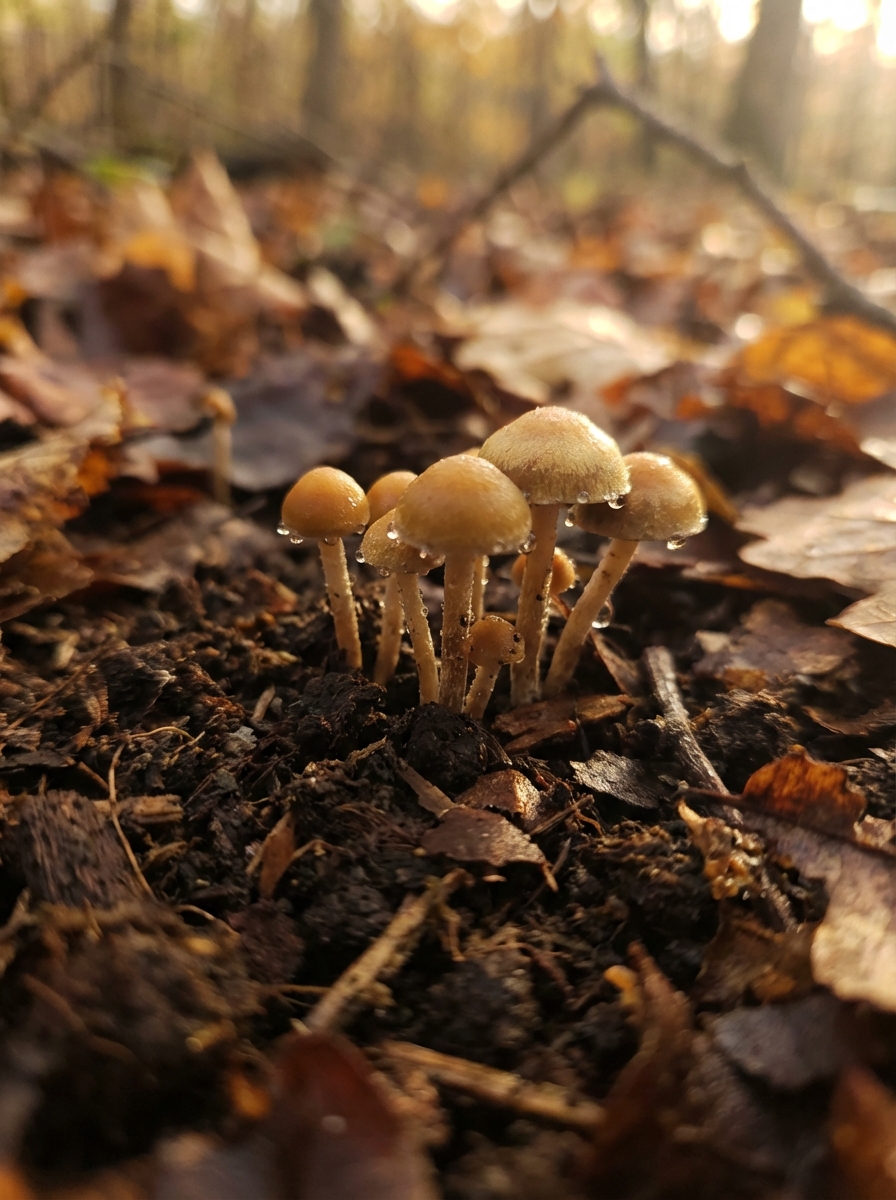
Peak Season (October-January): Cold, rainy conditions trigger fruiting. P. azurescens produces large, caramel-to-chestnut colored caps (4-10cm diameter) with wavy edges when mature. A well-established bed can produce dozens of fruiting bodies per flush.
Identification of P. azurescens
Knowing what you're harvesting is critical — particularly because the wood chip habitat is shared with Galerina marginata, which is deadly.
P. azurescens characteristics:
- Cap: Broadly conical to planar when mature, caramel to chestnut brown, strongly hygrophanous (color changes dramatically with moisture), up to 10cm
- Gills: Adnate to sinuate, initially gray-white becoming dark purple-brown
- Stem: 8-20cm tall, silky-fibrous, often with blue-green oxidation from handling
- Spore print: Dark purple-brown (NOT rusty orange)
- Blueing: Intense blue coloration when bruised or cut
Deadly lookalike — Galerina marginata:
- Similar size and habitat (wood debris)
- Rusty orange-brown spore print (versus purple-brown in azurescens)
- Often has a small ring (annulus) on the stem
- Does NOT blue when bruised
- Contains amatoxins — 1-2 caps is a lethal dose
Do not harvest without confirming the spore print color. This requires taking a spore print from any mushroom you're uncertain about.
Year-Over-Year Bed Management
An established P. azurescens bed can produce for 4-5 years or longer:
- Refresh the substrate: Add fresh wood chips each spring to provide new substrate for the mycelium
- Manage moisture: Supplement with water during dry summers
- Expand: Over time, the mycelium will spread beyond the original bed boundary
The naturalized mycelium network becomes more robust each year, typically producing larger and more consistent flushes as it establishes.
The Potency Consideration
P. azurescens is significantly more potent than P. cubensis. Doses appropriate for cubensis should not be directly translated. A 1g dried azurescens dose may be equivalent to 3-4g of dried cubensis. Start with substantially lower doses than you would use with cubensis. This is particularly important because the potency can vary by specimen and conditions.
Common Problems & Troubleshooting
See the Contamination Guide for common issues.
Tips for Success
Take notes at every stage. Consistency beats perfection.