Shotgun Fruiting Chamber
Everything you need to know about Shotgun Fruiting Chamber — from materials to first harvest.

What You'll Need
- See full supply list in guide below.
Find grow supplies at vendors in our Directory.
Step-by-Step Process
Shotgun Fruiting Chamber (SGFC): Setup and Use
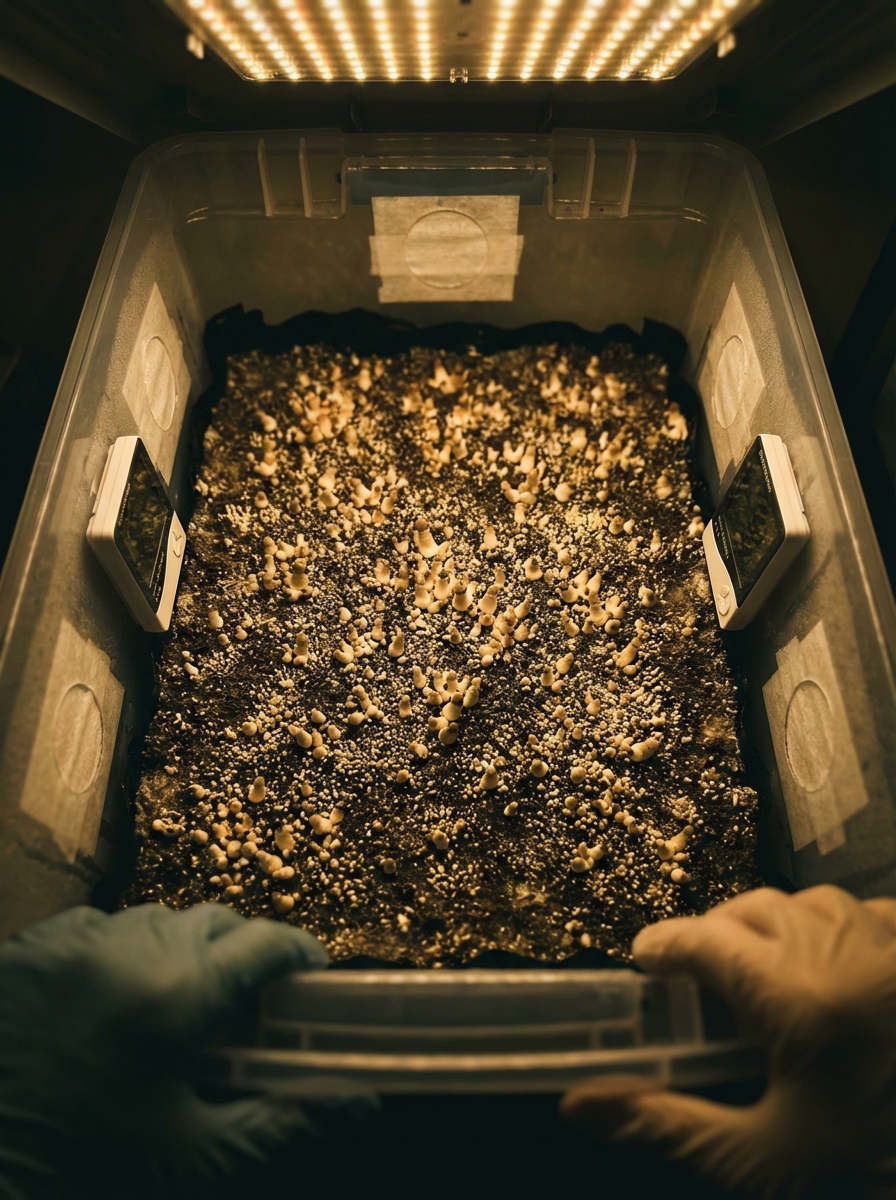
The Shotgun Fruiting Chamber (SGFC) is the most popular fruiting chamber design for small-scale home cultivation. It's inexpensive ($10–20 in materials), simple to build, and highly effective. The design works by creating passive airflow through dozens of small holes drilled into all six sides of a clear plastic storage tote, with humid perlite at the bottom acting as a passive evaporation reservoir.
The name "shotgun" refers to the hole pattern — the sides look like they were blasted with buckshot. The design was popularized on shroomery.org in the early 2000s and remains the standard recommendation for PF Tek cakes, Uncle Ben's Tek blocks, and small bulk monotubs.
Why SGFC Works
A fruiting mushroom needs three things simultaneously:
- High humidity (90–95% relative humidity)
- Fresh air exchange (FAE) — CO₂ must leave, O₂ must enter
- Indirect light — to orient pin formation
Standard sealed containers satisfy humidity but choke on CO₂ buildup. Standard open containers have fresh air but lose humidity instantly. The SGFC solves both problems: the perlite bed maintains humidity through passive evaporation, while the holes on all sides allow passive air movement without requiring fans or mechanical ventilation.
Materials and Tools
Materials
| Item | Cost Estimate | |------|---------------| | Clear plastic storage tote (50–66 qt capacity, shoe-box style aspect ratio) | $8–15 | | Coarse perlite (2–3 lbs) | $5–10 | | Distilled or filtered water | minimal | | Nylon stocking or fine mesh (optional, prevents perlite from falling through gaps) | $2 |
Tools
- ¼-inch drill bit and drill
- Measuring tape or ruler
- Marker
- Safety glasses
Step 1: Choose the Right Tote
Not all plastic totes are equal. Prioritize:
- Clear or semi-transparent walls — mushrooms orient toward light; clear sides allow you to monitor without opening
- Tall proportions — taller is better than wide; 16+ inches interior height allows pins to elongate without hitting the lid
- Secure lid — should clip or press firmly to create a somewhat enclosed environment (though the holes mean it's never fully sealed)
Recommended: Sterilite 60-quart gasket-lidded tote or similar. Available at Target, Walmart, or Home Depot.
Step 2: Drill the Holes
The hole pattern is critical. Too few holes = CO₂ buildup and metabolite issues. Too many holes = humidity drops too fast.
Standard SGFC Pattern
- ¼-inch holes, 2 inches apart, on all 6 surfaces — including the bottom and the lid
- For a standard 66-quart tote: this produces approximately 50–70 holes per side
Drilling Technique
- Mark holes with a marker using a ruler as a guide — 2 inches from each edge, then 2 inches apart in a grid pattern.
- Drill from the outside in to minimize burring.
- If the plastic cracks or burrs badly, slow down and apply less pressure.
Don't skip the bottom holes — the perlite drainage through bottom holes creates downward airflow that helps cycle fresh air in through the sides.
Step 3: Prepare the Perlite Bed
Perlite is a volcanic glass that absorbs water and releases it slowly through evaporation. It's the passive humidification mechanism that makes the SGFC work without constant attention.
Add Perlite
- Pour 2–3 inches of coarse perlite into the bottom of the tote.
- Rinse perlite under water until it runs clear (removes dust).
- Drain thoroughly — perlite should be moist but not sitting in standing water.
- Spread evenly across the bottom.
Hydrate the Perlite
Spray perlite with distilled water until it looks moist throughout. Tilt the tote — no water should pool or drain out. If it pools, it's too wet; let it evaporate more or remove some perlite.
Well-hydrated perlite maintains 85–95% relative humidity inside the SGFC without active intervention.
Step 4: Elevate Cakes Off the Perlite
Cakes and blocks must not rest directly on the wet perlite — direct contact causes base contamination.
Use any of the following:
- Aluminum foil squares folded into 1-inch squares under each cake corner
- Plastic bottle caps — 4 per cake
- A wire rack or mesh sitting on the perlite
- Shot glasses (the plastic kind)
The goal is to keep the bottom of each cake 1–2 inches above the perlite surface.
Step 5: Place Cakes and Initiate Fruiting
Birthing PF Tek Cakes
- After full colonization (plus 7-day consolidation), birth cakes from jars by running a knife around the inside edge and inverting.
- Dunk (optional but recommended): Submerge each cake in cold water for 12–24 hours before placing in the SGFC. This rehydrates the interior and significantly boosts the first flush yield.
- Roll in dry vermiculite: Roll the wet cake in a shallow dish of dry vermiculite until coated. This creates a moisture-holding surface layer and reduces direct evaporation from the cake surface.
Place in SGFC
- Arrange cakes on their elevated platforms with several inches of space between them for airflow.
- Leave at least 4–6 inches of vertical space above the cakes for pin elongation.
Step 6: Fruiting Conditions and Daily Maintenance
Environment
| Parameter | Target | |-----------|--------| | Temperature | 70–75°F (21–24°C) | | Humidity | 90–95% RH | | Light | 12 hours indirect light per day | | FAE | Passive through holes; fan briefly 2x/day |
Daily Routine (5 minutes)
- Mist the inside walls of the SGFC lightly — not the cakes directly. Water droplets on mushroom caps cause ugly yellow blotching.
- Fan by lifting the lid and fanning 5–10 times with it, then replacing.
- Inspect cakes and perlite — remove any dead pins or mycelium that looks off.
Refilling Perlite
Every 2–3 days, re-spray the perlite until it's fully moist again. You'll hear a slight evaporative hiss if you listen closely when the lid is on — this is normal and indicates the system is working.
Step 7: Harvesting
When to Harvest
Pick mushrooms before or as soon as the veil tears. The veil is the thin membrane underneath the cap connecting it to the stem. Once it tears:
- Spores drop (purple-black cloud)
- The mushroom's potency begins declining
- Spore deposits on the cake surface promote future contamination
How to Harvest
Grip the base of the mushroom stem near the substrate. Twist 90 degrees while pulling gently upward. The mycelium releases cleanly with a satisfying pop. Avoid tearing or leaving base stubs.
Between Flushes
- Remove all spent stem bases and aborted pins (soft, yellow, or dead-looking)
- Give each cake a dunk in cold water for 12–24 hours to rehydrate
- Return to SGFC and resume normal fruiting conditions
Expect 3–5 flushes from PF Tek cakes in an SGFC. Yield typically peaks at flush 2 and declines gradually after flush 3.
Humidity Troubleshooting
| Symptom | Diagnosis | Fix | |---------|-----------|-----| | Caps cracking or edges curling | Too dry | Mist more frequently; add more perlite | | Pins abort at 1–2cm | CO₂ buildup or too dry | Fan more aggressively; add holes | | Mold on cake sides | Too wet or low airflow | Reduce misting; fan more | | Yellow blotches on caps | Direct water contact | Mist walls only, not caps | | No pins after 2 weeks of fruiting | Needs stimulus | Lower temp to 65°F overnight; give dunk | | Pins on the side or bottom of cakes | Normal (side and butt pins) | Rotate cake; these are harvestable |
Scaling Up
The SGFC naturally outgrows itself when you want larger harvests. Once comfortable with SGFC, the logical next step is a monotub — a larger tote with bulk substrate rather than individual cakes. Many growers run 1–2 SGFCs while they learn, then transition to monotub for efficiency.
The skills transfer directly: sterile technique, humidity management, harvest timing, and contamination recognition are the same regardless of scale.
SGFC vs. Alternatives
| Fruiting Method | Cost | Difficulty | Yield | Best For | |-----------------|------|------------|-------|----------| | SGFC | $15–25 | Easy | Medium | PF Tek cakes, beginners | | Monotub | $20–40 | Medium | High | Grain spawn + bulk | | Martha tent | $100–200 | Medium | Very high | Serious hobbyists | | Martha with automation | $200–500 | Hard | Maximum | Commercial scale |
The SGFC is the best balance of simplicity and yield for the first 6–12 months of cultivation.
Common Problems & Troubleshooting
See the Contamination Guide for common issues.
Tips for Success
Take notes at every stage. Consistency beats perfection.