
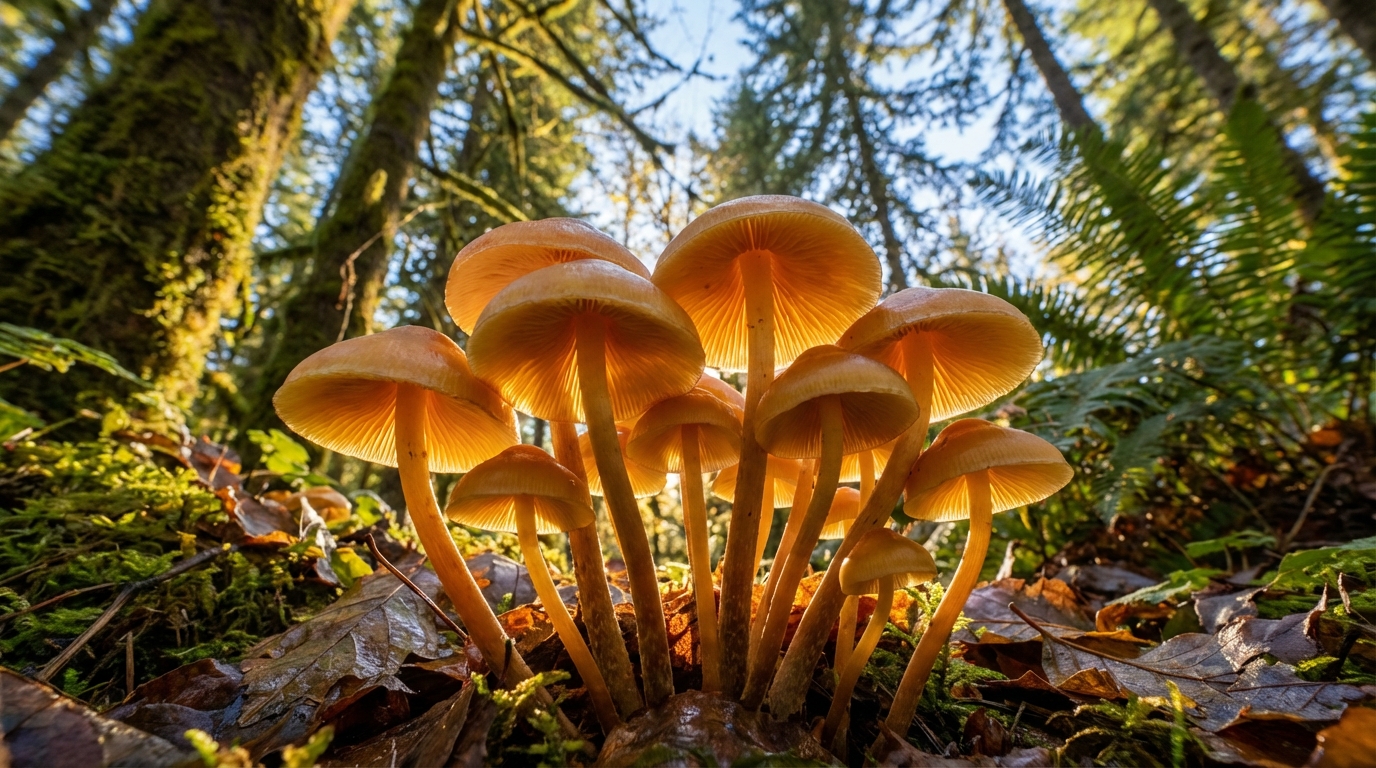
Panaeolus cambodginiensis
Common name: Cambodian Panaeolus
Field Identification
| Cap | 1.5–3cm; convex to broadly convex; gray-brown to buff when moist, pale gray when dry; smooth surface |
| Gills | Adnate; gray becoming jet black with spore maturity; mottled appearance from uneven spore development |
| Stem | 8–15cm tall; slender, stiff; pale gray to whitish; fine white fibrils on lower portion |
| Spore Print | Jet black |
| Habitat | Dung of water buffalo, cattle, and horses; tropical and subtropical grasslands and paddocks |
| Distribution | Southeast Asia (Cambodia, Vietnam, Thailand, Philippines), tropical regions globally |
| Season | Year-round in tropical climates; peak during rainy season |
Key Identification Feature
The mottled gill pattern (irregular black from uneven spore ripening) is the primary Panaeolus identifier. Unlike Psilocybe, the spore print is jet black rather than purple-brown. Grows exclusively on dung, not soil or wood.
⚠ Dangerous Lookalikes
Non-active Panaeolus species (papilionaceus, antillarum); Coprinus/Coprinoid species (ink caps, which autodigest)
Notes
Panaeolus cambodginiensis is significant in the mycology of psychedelic mushrooms because it lacks the characteristic blue bruising reaction that most foragers and growers use as a potency indicator. Despite containing psilocybin, the enzymatic pathway that produces the bluing reaction appears to be absent or limited. This makes field identification more challenging than with Psilocybe species. The jet black spore print (compared to purple-brown in Psilocybe) and mottled gill pattern are the reliable identifiers. The species grows in the same tropical dung habitats as P. cubensis and can be mistakenly mixed with cubensis harvests.
All Wild Species
- Psilocybe semilanceata (Liberty Cap)
- Psilocybe azurescens (Flying Saucers, Azzies)
- Psilocybe cyanescens (Wavy Caps, Blue Halos)
- Psilocybe mexicana (Teonanácatl (historical Mazatec name))
- Panaeolus cyanescens (Blue Meanies, Pan Cyan)
- Psilocybe tampanensis (Magic Truffles, Philosopher's Stones)
- Psilocybe baeocystis (Bottle Cap, Blue Bell, Knobby Tops)
- Psilocybe allenii (Allen's Psilocybe)
- Psilocybe subaeruginosa (Sub (Australian/New Zealand))
- Psilocybe cubensis (wild) (Gold Caps (wild), Cubes (wild))
- Psilocybe ovoideocystidiata (Ovoids, Blue Ringers)
- Psilocybe tampanensis (Philosopher's Stone, Magic Truffle)
- Psilocybe mexicana (Teonanácatl (historical), Magic Truffle Source)
- Gymnopilus junonius (Spectacular Rustgill, Big Laughing Gym)
- Panaeolus cyanescens (Blue Meanie, Blue Meanies)
- Psilocybe subaeruginosa (Subs (Australia), Australian Magic Mushroom)
- Psilocybe semilanceata (Liberty Cap)
- Psilocybe stuntzii (Blue Ringers, Stuntz's Blue Legs)
- Psilocybe hoogshagenii (Las Derrumbes (Mazatec))
- Psilocybe tampanensis (Magic Truffles, Philosopher's Stones)
- Psilocybe subaeruginosa (Australian Magic Mushroom, Sub)
- Psilocybe bohemica (Bohemian Psilocybe)
- Psilocybe mexicana (Teonanácatl)
- Psilocybe weilii (Weil's Psilocybe)
- Panaeolus cinctulus (Banded Mottlegill)
- Psilocybe tampanensis (Philosopher's Stone / Magic Truffle)
- Psilocybe hoogshagenii (Little Boy Mushroom / Niño de las Aguas)
- Gymnopilus junonius (Spectacular Rustgill)
- Psilocybe samuiensis (Samui Psilocybe)
- Psilocybe galindoi (Galindoi Truffle / Philosopher's Stone variant)
- Psilocybe subaeruginosa (Aussie Gold / Australian Blue Meanies)
- Panaeolus cambodginiensis (Cambodian Panaeolus)
- Psilocybe stuntzii (Blue Ringers / Stuntz's Psilocybe)
- Psilocybe ovoideocystidiata (Ovoid Cystidium Psilocybe)
- Psilocybe zapotecorum (Zapotec Mushroom)
- Psilocybe caerulipes (Blue Foot Psilocybe)
- Conocybe cyanopus (Blue-Footed Conocybe)
- Psilocybe fimetaria (Dung Roundhead)
- Psilocybe baeocystis (Bottle Cap, Knobby Tops)
- Psilocybe quebecensis (Quebec Psilocybe)
- Inocybe aeruginascens (Verdigris Inocybe)
- Pluteus salicinus (Willow Shield)
- Psilocybe allenii (Allen's Psilocybe)
- Psilocybe cinctulus (Belt Psilocybe)
- Psilocybe natalensis (Natal Psilocybe)
- Psilocybe pelliculosa (Conifer Psilocybe)
- Psilocybe strictipes (Straight-Stem Psilocybe)
- Gymnopilus luteofolius (Yellow-Gilled Gymnopilus)
- Psilocybe cyanofibrillosa (Blue-Fibered Psilocybe)
- Psilocybe silvatica (Forest Psilocybe)
- Psilocybe subcubensis (Subtropical Cubensis)
- Psilocybe fagicola (Beech Psilocybe)
- Psilocybe muliercula (Lady Psilocybe)
- Psilocybe angustipleurocystidiata (Narrow-Cystidiate Psilocybe)
- Psilocybe atrobrunnea (Dark Brown Bog Psilocybe)
- Psilocybe zapotecorum (Zapotec Psilocybe)
- Psilocybe aztecorum (Aztec Psilocybe)
- Psilocybe cubensis (Hawaii strain) (Hawaiian Cubensis)
- Panaeolus antillarum (Tropical Panaeolus)
- Psilocybe semilanceata (UK populations) (Liberty Cap (UK))
- Psilocybe galindoi (Atlanta Strain Psilocybe)
- Gymnopilus aeruginosus (Malachite Gymnopilus)
- Psilocybe hispanica (Spanish Psilocybe)
- Psilocybe meridionalis (Southern Psilocybe)
- Panaeolus fimicola (Turf Mottlegill)