
Psilocybe stuntzii
Common name: Stuntz's Blue Legs, Blue Ringers
Field Identification
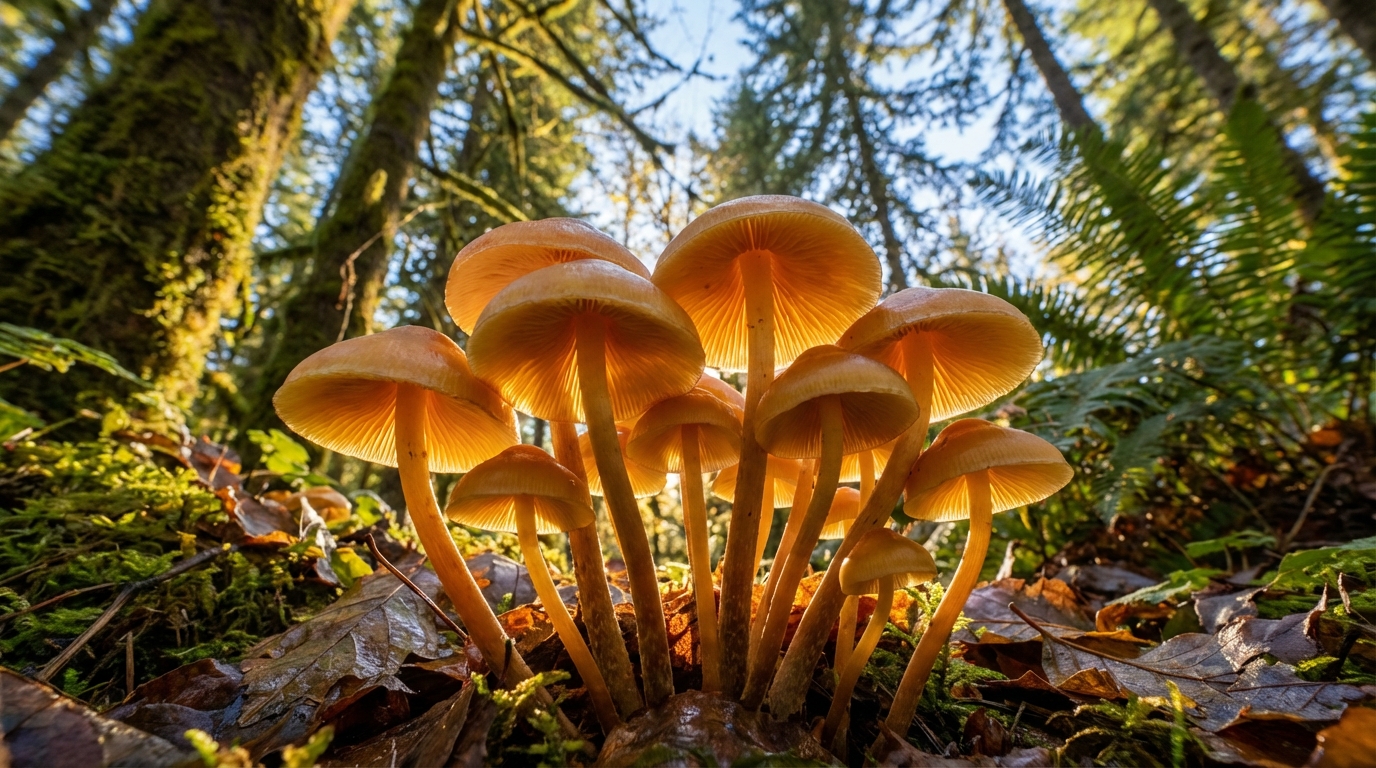
| Cap | 1-4cm; convex to broadly convex; caramel-brown; hygrophanous, fading to pale straw |
| Gills | Adnate; pale at first, darkening to purple-brown; close |
| Stem | 3-8cm; pale to whitish; persistent ring often present; blue-green tinting at base |
| Spore Print | Dark purple-brown; ellipsoid, 10-13 x 6-8 um |
| Habitat | Wood chips, lawns, grassy areas; commonly in urban landscaped areas |
| Distribution | Pacific Northwest US and Canada (Washington, Oregon, British Columbia) |
| Season | Late summer through winter (August-February) |
Key Identification Feature
Blue-green staining at stem base. Persistent ring on stem. Small size. Common in urban wood chip beds of the Pacific Northwest.
⚠ Dangerous Lookalikes
Galerina marginata (DEADLY TOXIC — grows in same habitat; lacks ring bluing; rusty spore print). Pholiota species (non-psychoactive, brown spores).
Notes
One of the first Psilocybe species documented spreading into urban environments via wood chip landscaping. Psilocybin content is low (0.2-0.6%) compared to other cultivated species. Named after mycologist Daniel Stuntz.
Legal Status Warning
Psilocybin-containing mushrooms are controlled substances in most jurisdictions. This guide is for educational purposes only. Wild foraging for psilocybin mushrooms may be illegal in your location. Never consume wild mushrooms without positive identification from an expert mycologist — misidentification can be fatal.
All Wild Species
- Psilocybe semilanceata (Liberty Cap)
- Psilocybe azurescens (Flying Saucers, Azzies)
- Psilocybe cyanescens (Wavy Caps, Blue Halos)
- Psilocybe mexicana (Teonanácatl (historical Mazatec name))
- Panaeolus cyanescens (Blue Meanies, Pan Cyan)
- Psilocybe tampanensis (Magic Truffles, Philosopher's Stones)
- Psilocybe subaeruginosa (Subs (Australia/NZ))
- Psilocybe stuntzii (Stuntz's Blue Legs, Blue Ringers)
- Psilocybe bohemica (Bohemian Psilocybe)
- Psilocybe pelliculosa (Conifer Psilocybe)
- Psilocybe weilii (Weil's Psilocybe)
- Psilocybe hoogshagenii (Derrumbe)
- Gymnopilus spectabilis (Big Laughing Gym, Spectacular Rustgill)
- Psilocybe strictipes (Rigid-Stemmed Psilocybe)
- Psilocybe cyanofibrillosa (Blue-Haired Psilocybe, Rhododendron Psilocybe)
- Psilocybe samuiensis (Ko Samui Psilocybe)
- Psilocybe aucklandii (Auckland Psilocybe)
- Psilocybe galindoi (ATLantis truffle, Philosopher's Stone (cultivated form))
- Psilocybe natalensis (Natal Super Strength)
- Psilocybe liniformans (European liberty cap lookalike)
- Psilocybe fimetaria (Dung loving psilocybe)
- Psilocybe makarorae (New Zealand native psilocybe)
- Psilocybe caerulipes (Blue-foot psilocybe)
- Psilocybe ovoideocystidiata (Ovoid cystidiate psilocybe)
- Psilocybe zapotecorum (Zapotec sacred mushroom)
- Psilocybe serbica (Bohemian psilocybe (var. serbica))
- Gymnopilus purpuratus (Purple Gymnopilus)