
Gymnopilus spectabilis
Common name: Big Laughing Gym, Spectacular Rustgill
Field Identification
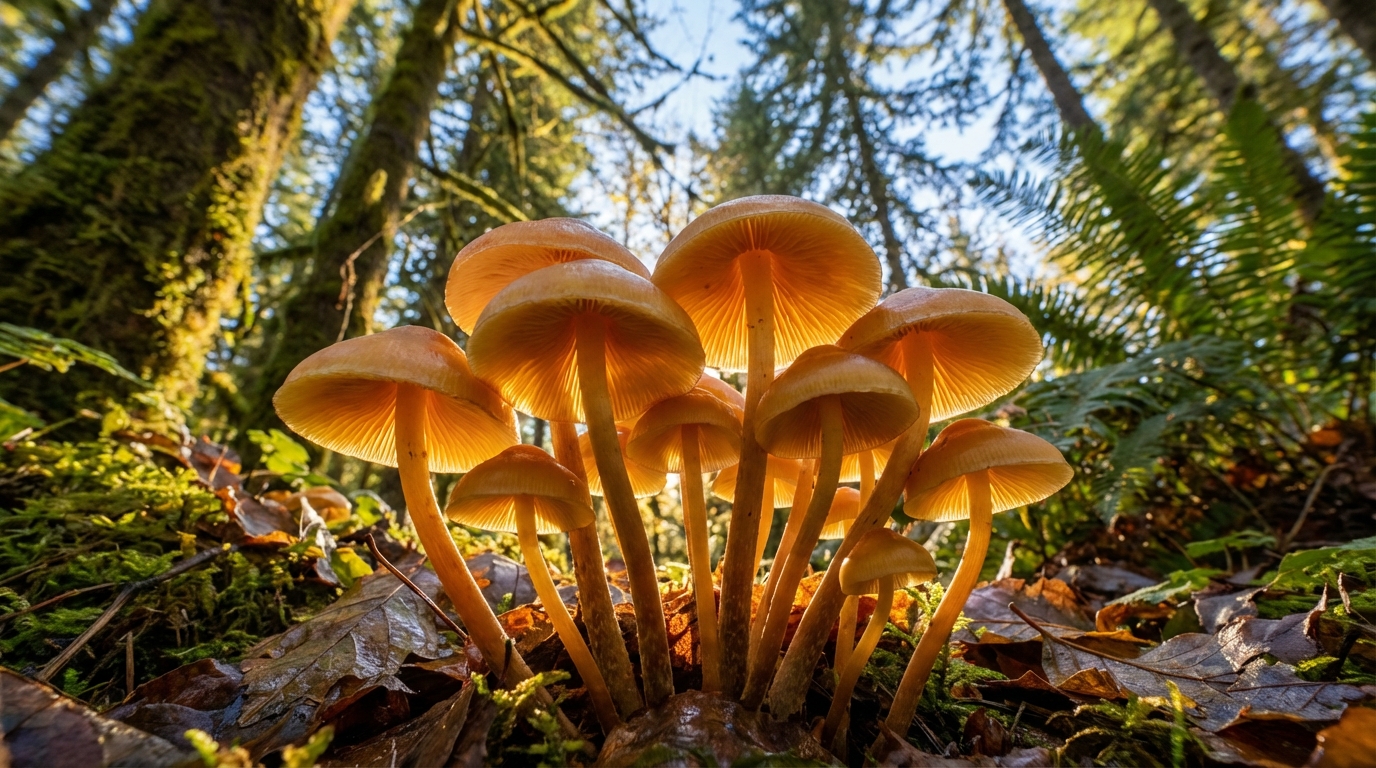
| Cap | 5-20cm; broadly convex; bright orange-yellow to rusty-orange; dry; firm flesh |
| Gills | Adnate to slightly decurrent; crowded; initially pale yellow, becoming rusty-orange with spores |
| Stem | 5-15cm; fibrous; same color as cap; ring present; base often attached to wood |
| Spore Print | Rusty-orange to rust-brown; ellipsoid to almond-shaped, 7-10 x 4-6 um |
| Habitat | Decaying hardwood stumps, large logs, roots; sometimes conifers |
| Distribution | North America, Europe, East Asia, Australia — worldwide on hardwoods |
| Season | Late summer through autumn |
Key Identification Feature
Large size, vivid orange color, rusty spore print (NOT purple-brown), bitter taste. Grows on or at base of dead hardwood. Variable psychoactive content — many specimens contain no psilocybin.
⚠ Dangerous Lookalikes
Gymnopilus junonius (closely related, also variable activity, similar appearance); Pholiota species (non-psychoactive, similar habitat); Flammulina (velvet shank, different structure)
Notes
Unlike true Psilocybe species, G. spectabilis does NOT have a purple-brown spore print — spores are rusty-orange. Psychoactive alkaloid content varies enormously between specimens; some contain no psilocybin. Associated with uncontrollable laughter in traditional Japanese accounts — possibly the origin of soma legends in some theories.
All Wild Species
- Psilocybe semilanceata (Liberty Cap)
- Psilocybe azurescens (Flying Saucers, Azzies)
- Psilocybe cyanescens (Wavy Caps, Blue Halos)
- Psilocybe mexicana (Teonanácatl (historical Mazatec name))
- Panaeolus cyanescens (Blue Meanies, Pan Cyan)
- Psilocybe tampanensis (Magic Truffles, Philosopher's Stones)
- Psilocybe subaeruginosa (Subs (Australia/NZ))
- Psilocybe stuntzii (Stuntz's Blue Legs, Blue Ringers)
- Psilocybe bohemica (Bohemian Psilocybe)
- Psilocybe pelliculosa (Conifer Psilocybe)
- Psilocybe weilii (Weil's Psilocybe)
- Psilocybe hoogshagenii (Derrumbe)
- Gymnopilus spectabilis (Big Laughing Gym, Spectacular Rustgill)
- Psilocybe strictipes (Rigid-Stemmed Psilocybe)
- Psilocybe cyanofibrillosa (Blue-Haired Psilocybe, Rhododendron Psilocybe)
- Psilocybe samuiensis (Ko Samui Psilocybe)
- Psilocybe aucklandii (Auckland Psilocybe)
- Psilocybe galindoi (ATLantis truffle, Philosopher's Stone (cultivated form))
- Psilocybe natalensis (Natal Super Strength)
- Psilocybe liniformans (European liberty cap lookalike)
- Psilocybe fimetaria (Dung loving psilocybe)
- Psilocybe makarorae (New Zealand native psilocybe)
- Psilocybe caerulipes (Blue-foot psilocybe)
- Psilocybe ovoideocystidiata (Ovoid cystidiate psilocybe)
- Psilocybe zapotecorum (Zapotec sacred mushroom)
- Psilocybe serbica (Bohemian psilocybe (var. serbica))
- Gymnopilus purpuratus (Purple Gymnopilus)