
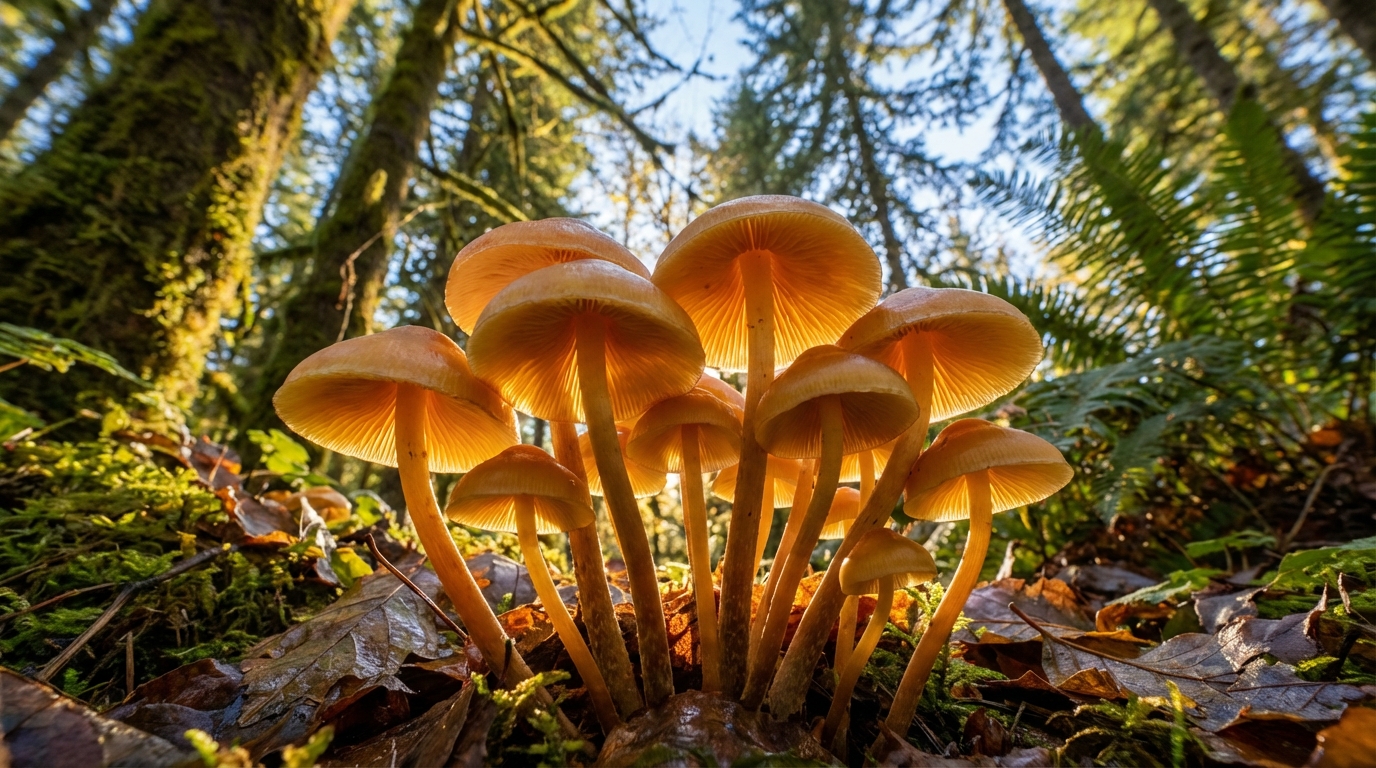
Conocybe cyanopus
Common name: Blue-Footed Conocybe
Field Identification
| Cap | 0.5–1.5cm; conic to campanulate; rust-brown to tawny; hygrophanous; smooth |
| Gills | Adnate; pale becoming rusty-brown at maturity; crowded |
| Stem | 3–8cm tall; very slender; pale; hollow; base characteristically blue-staining (giving the common name) — a rare feature in Conocybe |
| Spore Print | Rusty orange-brown — IMPORTANT: unlike psilocybin species which have dark purple-brown spores |
| Habitat | Grassy areas, lawns, compost-rich soil, disturbed ground; common in urban and suburban settings |
| Distribution | North America (widespread), Europe; occasionally reported in Australia |
| Season | Spring through autumn with sufficient moisture |
Key Identification Feature
The rusty-brown spore print (not purple-brown) combined with the blue-staining stem base is a critical identification combination. Most Conocybe species with rusty spores are NOT psychoactive. The blue foot is unusual for the genus — used for identification but does not indicate psilocybin content.
⚠ Dangerous Lookalikes
Conocybe filaris (DEADLY — similar appearance; amatoxin-containing; rusty spore print), Psilocybe species (IMPORTANT: distinguishable by spore color — Conocybe has rusty brown; Psilocybe has dark purple-brown), Galerina marginata (DEADLY)
Notes
Conocybe cyanopus is included in this guide primarily as an educational edge case. Most harm-reduction advice for psychoactive mushroom identification focuses on dark purple-brown spore prints as a positive indicator of psilocybin species. C. cyanopus breaks this rule — it contains psilocybin but produces rusty-brown spores typical of the Conocybe genus. This creates potential for confusion in both directions: mistaking it for a non-active Conocybe, or (more dangerously) assuming any blue-footed mushroom is safe. Do not harvest any Conocybe species for consumption — the deadly C. filaris is in the same genus, shares the rusty spore print, and occurs in similar habitats.
All Wild Species
- Psilocybe semilanceata (Liberty Cap)
- Psilocybe azurescens (Flying Saucers, Azzies)
- Psilocybe cyanescens (Wavy Caps, Blue Halos)
- Psilocybe mexicana (Teonanácatl (historical Mazatec name))
- Panaeolus cyanescens (Blue Meanies, Pan Cyan)
- Psilocybe tampanensis (Magic Truffles, Philosopher's Stones)
- Psilocybe baeocystis (Bottle Cap, Blue Bell, Knobby Tops)
- Psilocybe allenii (Allen's Psilocybe)
- Psilocybe subaeruginosa (Sub (Australian/New Zealand))
- Psilocybe cubensis (wild) (Gold Caps (wild), Cubes (wild))
- Psilocybe ovoideocystidiata (Ovoids, Blue Ringers)
- Psilocybe tampanensis (Philosopher's Stone, Magic Truffle)
- Psilocybe mexicana (Teonanácatl (historical), Magic Truffle Source)
- Gymnopilus junonius (Spectacular Rustgill, Big Laughing Gym)
- Panaeolus cyanescens (Blue Meanie, Blue Meanies)
- Psilocybe subaeruginosa (Subs (Australia), Australian Magic Mushroom)
- Psilocybe semilanceata (Liberty Cap)
- Psilocybe stuntzii (Blue Ringers, Stuntz's Blue Legs)
- Psilocybe hoogshagenii (Las Derrumbes (Mazatec))
- Psilocybe tampanensis (Magic Truffles, Philosopher's Stones)
- Psilocybe subaeruginosa (Australian Magic Mushroom, Sub)
- Psilocybe bohemica (Bohemian Psilocybe)
- Psilocybe mexicana (Teonanácatl)
- Psilocybe weilii (Weil's Psilocybe)
- Panaeolus cinctulus (Banded Mottlegill)
- Psilocybe tampanensis (Philosopher's Stone / Magic Truffle)
- Psilocybe hoogshagenii (Little Boy Mushroom / Niño de las Aguas)
- Gymnopilus junonius (Spectacular Rustgill)
- Psilocybe samuiensis (Samui Psilocybe)
- Psilocybe galindoi (Galindoi Truffle / Philosopher's Stone variant)
- Psilocybe subaeruginosa (Aussie Gold / Australian Blue Meanies)
- Panaeolus cambodginiensis (Cambodian Panaeolus)
- Psilocybe stuntzii (Blue Ringers / Stuntz's Psilocybe)
- Psilocybe ovoideocystidiata (Ovoid Cystidium Psilocybe)
- Psilocybe zapotecorum (Zapotec Mushroom)
- Psilocybe caerulipes (Blue Foot Psilocybe)
- Conocybe cyanopus (Blue-Footed Conocybe)
- Psilocybe fimetaria (Dung Roundhead)
- Psilocybe baeocystis (Bottle Cap, Knobby Tops)
- Psilocybe quebecensis (Quebec Psilocybe)
- Inocybe aeruginascens (Verdigris Inocybe)
- Pluteus salicinus (Willow Shield)
- Psilocybe allenii (Allen's Psilocybe)
- Psilocybe cinctulus (Belt Psilocybe)
- Psilocybe natalensis (Natal Psilocybe)
- Psilocybe pelliculosa (Conifer Psilocybe)
- Psilocybe strictipes (Straight-Stem Psilocybe)
- Gymnopilus luteofolius (Yellow-Gilled Gymnopilus)
- Psilocybe cyanofibrillosa (Blue-Fibered Psilocybe)
- Psilocybe silvatica (Forest Psilocybe)
- Psilocybe subcubensis (Subtropical Cubensis)
- Psilocybe fagicola (Beech Psilocybe)
- Psilocybe muliercula (Lady Psilocybe)
- Psilocybe angustipleurocystidiata (Narrow-Cystidiate Psilocybe)
- Psilocybe atrobrunnea (Dark Brown Bog Psilocybe)
- Psilocybe zapotecorum (Zapotec Psilocybe)
- Psilocybe aztecorum (Aztec Psilocybe)
- Psilocybe cubensis (Hawaii strain) (Hawaiian Cubensis)
- Panaeolus antillarum (Tropical Panaeolus)
- Psilocybe semilanceata (UK populations) (Liberty Cap (UK))
- Psilocybe galindoi (Atlanta Strain Psilocybe)
- Gymnopilus aeruginosus (Malachite Gymnopilus)
- Psilocybe hispanica (Spanish Psilocybe)
- Psilocybe meridionalis (Southern Psilocybe)
- Panaeolus fimicola (Turf Mottlegill)