
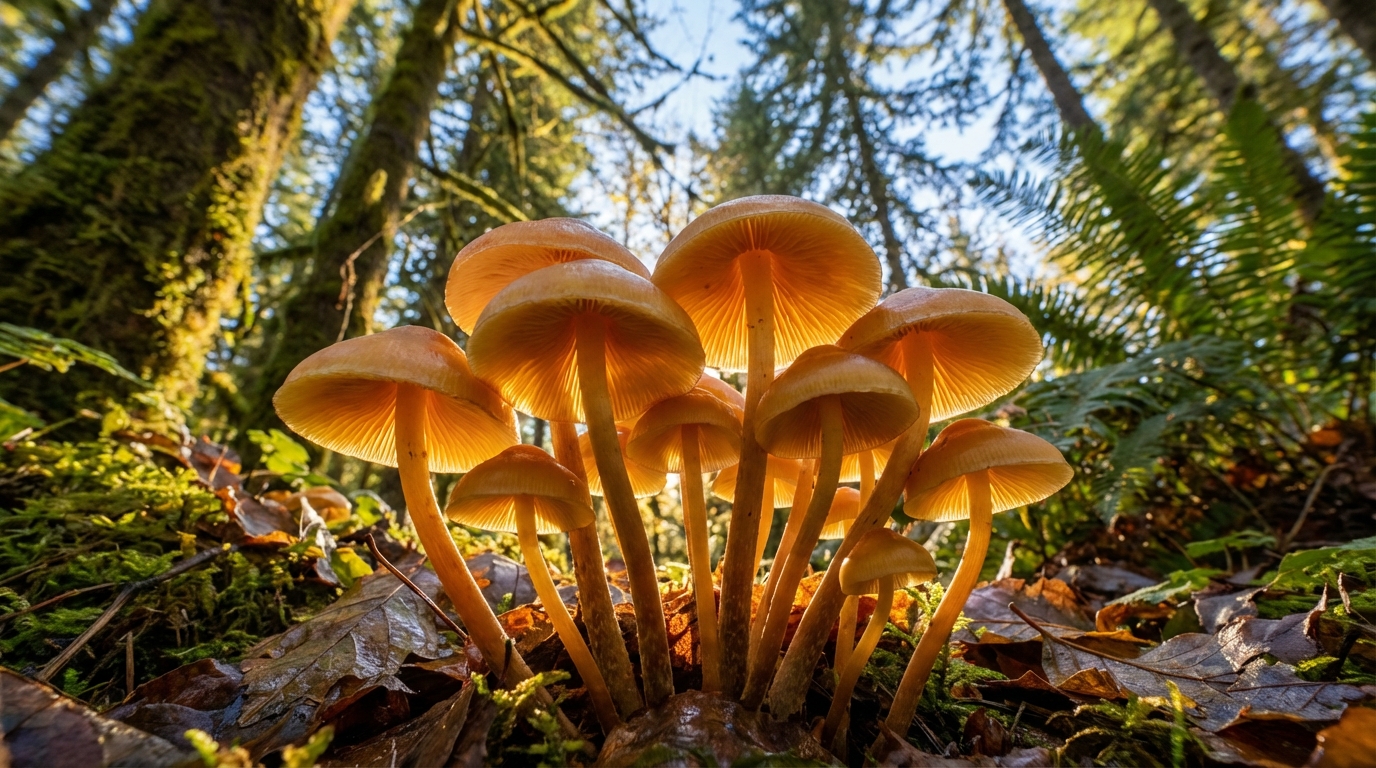
Gymnopilus luteofolius
Common name: Yellow-Gilled Gymnopilus
Field Identification
| Cap | 3–12 cm, convex to broadly umbonate, dry, yellow-orange to reddish-brown with dry fibrous surface |
| Gills | Adnate to slightly decurrent, yellow becoming rusty orange at maturity, crowded |
| Stem | 4–10 cm × 5–15 mm, fibrous, yellow-orange, often with membranous annulus |
| Spore Print | Ellipsoid, roughened (verrucose), 6–9 × 4–5 µm, rusty-orange spore print |
| Habitat | Dead hardwood logs and stumps, occasionally conifers |
| Distribution | Eastern and Pacific coast North America; parts of Europe |
| Season | July–November |
Key Identification Feature
Yellow gills on hardwood; rusty spore print; bitter taste; no veil ring in young specimens sometimes
⚠ Dangerous Lookalikes
Gymnopilus junonius (larger, more robust); Pholiota species (non-psychoactive, different ecology)
Notes
Potency is geographically variable — some North American collections are active, others are not. Bitter taste makes consumption unpleasant. Not a reliable psychedelic source.
Legal Status Warning
Psilocybin-containing mushrooms are controlled substances in most jurisdictions. This guide is for educational purposes only. Wild foraging for psilocybin mushrooms may be illegal in your location. Never consume wild mushrooms without positive identification from an expert mycologist — misidentification can be fatal.
All Wild Species
- Psilocybe semilanceata (Liberty Cap)
- Psilocybe azurescens (Flying Saucers, Azzies)
- Psilocybe cyanescens (Wavy Caps, Blue Halos)
- Psilocybe mexicana (Teonanácatl (historical Mazatec name))
- Panaeolus cyanescens (Blue Meanies, Pan Cyan)
- Psilocybe tampanensis (Magic Truffles, Philosopher's Stones)
- Psilocybe baeocystis (Bottle Cap, Blue Bell, Knobby Tops)
- Psilocybe allenii (Allen's Psilocybe)
- Psilocybe subaeruginosa (Sub (Australian/New Zealand))
- Psilocybe cubensis (wild) (Gold Caps (wild), Cubes (wild))
- Psilocybe ovoideocystidiata (Ovoids, Blue Ringers)
- Psilocybe tampanensis (Philosopher's Stone, Magic Truffle)
- Psilocybe mexicana (Teonanácatl (historical), Magic Truffle Source)
- Gymnopilus junonius (Spectacular Rustgill, Big Laughing Gym)
- Panaeolus cyanescens (Blue Meanie, Blue Meanies)
- Psilocybe subaeruginosa (Subs (Australia), Australian Magic Mushroom)
- Psilocybe semilanceata (Liberty Cap)
- Psilocybe stuntzii (Blue Ringers, Stuntz's Blue Legs)
- Psilocybe hoogshagenii (Las Derrumbes (Mazatec))
- Psilocybe tampanensis (Magic Truffles, Philosopher's Stones)
- Psilocybe subaeruginosa (Australian Magic Mushroom, Sub)
- Psilocybe bohemica (Bohemian Psilocybe)
- Psilocybe mexicana (Teonanácatl)
- Psilocybe weilii (Weil's Psilocybe)
- Panaeolus cinctulus (Banded Mottlegill)
- Psilocybe tampanensis (Philosopher's Stone / Magic Truffle)
- Psilocybe hoogshagenii (Little Boy Mushroom / Niño de las Aguas)
- Gymnopilus junonius (Spectacular Rustgill)
- Psilocybe samuiensis (Samui Psilocybe)
- Psilocybe galindoi (Galindoi Truffle / Philosopher's Stone variant)
- Psilocybe subaeruginosa (Aussie Gold / Australian Blue Meanies)
- Panaeolus cambodginiensis (Cambodian Panaeolus)
- Psilocybe stuntzii (Blue Ringers / Stuntz's Psilocybe)
- Psilocybe ovoideocystidiata (Ovoid Cystidium Psilocybe)
- Psilocybe zapotecorum (Zapotec Mushroom)
- Psilocybe caerulipes (Blue Foot Psilocybe)
- Conocybe cyanopus (Blue-Footed Conocybe)
- Psilocybe fimetaria (Dung Roundhead)
- Psilocybe baeocystis (Bottle Cap, Knobby Tops)
- Psilocybe quebecensis (Quebec Psilocybe)
- Inocybe aeruginascens (Verdigris Inocybe)
- Pluteus salicinus (Willow Shield)
- Psilocybe allenii (Allen's Psilocybe)
- Psilocybe cinctulus (Belt Psilocybe)
- Psilocybe natalensis (Natal Psilocybe)
- Psilocybe pelliculosa (Conifer Psilocybe)
- Psilocybe strictipes (Straight-Stem Psilocybe)
- Gymnopilus luteofolius (Yellow-Gilled Gymnopilus)
- Psilocybe cyanofibrillosa (Blue-Fibered Psilocybe)
- Psilocybe silvatica (Forest Psilocybe)
- Psilocybe subcubensis (Subtropical Cubensis)
- Psilocybe fagicola (Beech Psilocybe)
- Psilocybe muliercula (Lady Psilocybe)
- Psilocybe angustipleurocystidiata (Narrow-Cystidiate Psilocybe)
- Psilocybe atrobrunnea (Dark Brown Bog Psilocybe)
- Psilocybe zapotecorum (Zapotec Psilocybe)
- Psilocybe aztecorum (Aztec Psilocybe)
- Psilocybe cubensis (Hawaii strain) (Hawaiian Cubensis)
- Panaeolus antillarum (Tropical Panaeolus)
- Psilocybe semilanceata (UK populations) (Liberty Cap (UK))
- Psilocybe galindoi (Atlanta Strain Psilocybe)
- Gymnopilus aeruginosus (Malachite Gymnopilus)
- Psilocybe hispanica (Spanish Psilocybe)
- Psilocybe meridionalis (Southern Psilocybe)
- Panaeolus fimicola (Turf Mottlegill)