Psilocybin vs. MDMA: How the Two Therapeutic Psychedelics Compare
Psilocybin and MDMA are both advancing through clinical development as therapeutic tools, but they are pharmacologically distinct substances with different mechanisms, different evidence bases, different therapeutic targets, and very different ses...
Psilocybin vs. MDMA: How the Two Therapeutic Psychedelics Compare
Psilocybin and MDMA are both advancing through clinical development as therapeutic tools, but they are pharmacologically distinct substances with different mechanisms, different evidence bases, different therapeutic targets, and very different session experiences. Confusing them is common in media coverage. This guide explains the differences.
The Quick Summary
| | Psilocybin | MDMA | |---|---|---| | Session duration | 4–6 hours | 3–5 hours | | Primary mechanism | 5-HT2A agonist | Serotonin/dopamine release | | Subjective character | Visionary, introspective, consciousness-expanding | Empathogenic, relational, emotional openness | | Main therapeutic targets | Depression, addiction, anxiety, OCD, cancer anxiety | PTSD, relationship/relational trauma | | Evidence strength | Phase 2/3 for depression; Phase 2 for others | Phase 3 for PTSD (MAPS) | | FDA status | NDA expected 2026-2027 (COMPASS) | FDA rejected MAPS NDA 2024 (re-submission in progress) | | Physiological safety | Excellent — no organ toxicity, no LD50 | Generally safe; cardiac considerations at high doses | | Risk profile | Psychological (psychosis risk in vulnerable) | Psychological; neurotoxicity at high repeated doses | | DEA Schedule | Schedule I | Schedule I |
Mechanism
Psilocybin is a prodrug — it converts to psilocin in the body. Psilocin is a classical psychedelic that acts primarily as a partial agonist at serotonin 5-HT2A receptors in the cortex. This disrupts the default mode network (the brain's "self" network), increases global brain entropy, and temporarily flattens the hierarchical predictive structure that maintains rigid patterns of thought and behavior (the REBUS model). It also drives post-session neuroplasticity through BDNF elevation.
MDMA is an entactogen — it causes massive release of serotonin, dopamine, and norepinephrine, while also releasing oxytocin. It does not primarily agonize 5-HT2A receptors. The result is not a psychedelic experience in the visual/perceptual sense — it's a profound emotional opening, reduction of fear response (amygdala suppression), and increase in feelings of trust and connection. It enables processing of traumatic memories without the fear that typically makes them inaccessible.
The Therapeutic Experience
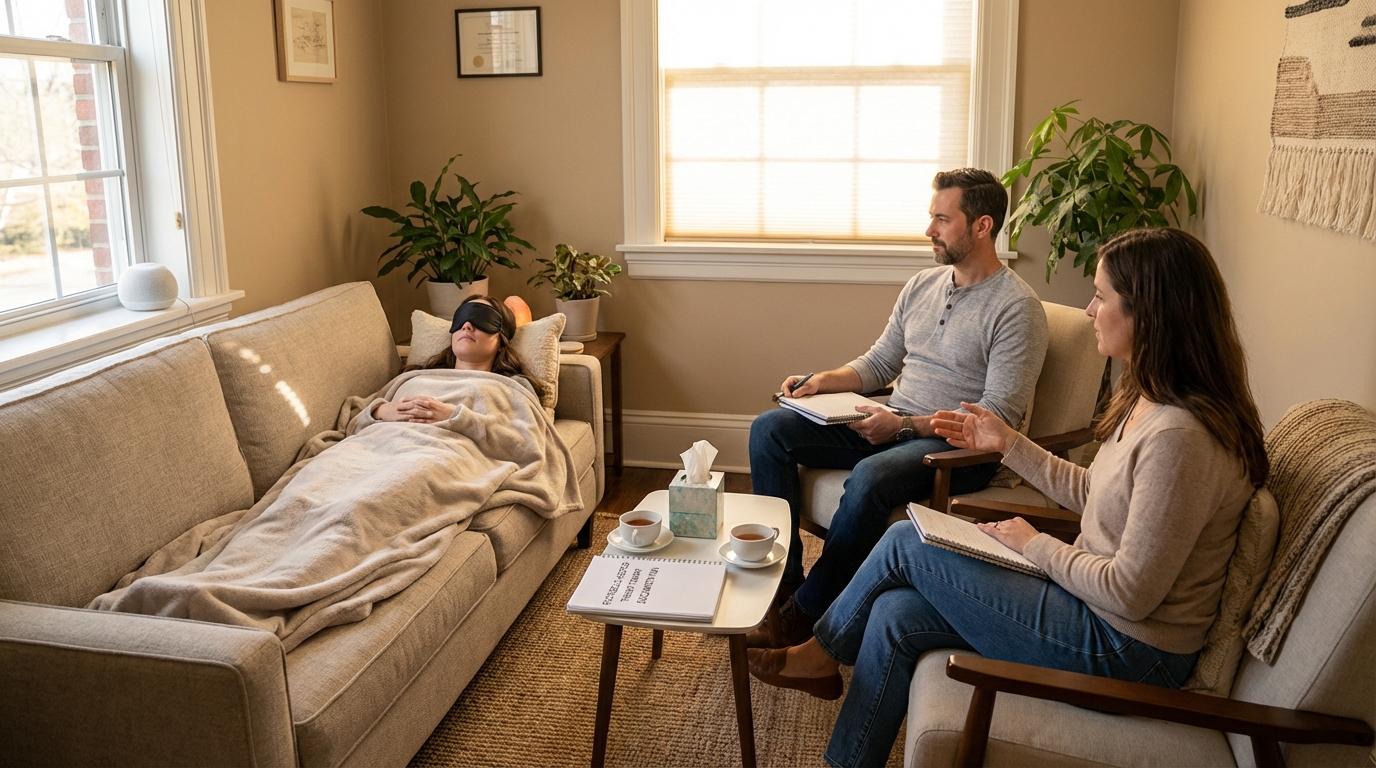
Psilocybin session: Consciousness-expanding. Typically involves internal imagery, dissolution of usual ego-boundaries, encounter with unconscious material, and often mystical or transcendent experience. The therapeutic work happens largely during the session itself — what arises in the experience is the content to be processed. Music and a comfortable, safe environment are essential. The session is often called "entering difficult territory."
MDMA session: Empathogenic, relational. Participants remain conversational and cognitively clear — they can talk about traumatic experiences without being overwhelmed by them because MDMA reduces the amygdala's fear response. The therapeutic work in MAPS's protocol involves guided talk therapy with therapists during the session. It enables trauma processing that would otherwise be too dysregulating. Less visionary; more explicitly verbal and interpersonal.
Evidence Base
Psilocybin
- Treatment-resistant depression: COMPASS Phase 3 RCT (n=233); Hopkins Phase 2 RCT; Imperial College London psilocybin vs. escitalopram comparison
- Cancer anxiety and end-of-life distress: Hopkins and NYU landmark trials (n=80+), effect sizes among the largest in psychiatric literature
- Alcohol use disorder: NYU Phase 2 RCT (n=93), JAMA Psychiatry 2022
- Smoking cessation: Hopkins open-label Phase 2 (n=15), 80% abstinence at 6 months
- OCD: Arizona open-label pilot; Yale RCT ongoing
MDMA
- PTSD: MAPS Phase 3 trials (n=90+), published in Nature Medicine 2021 — 67% no longer met PTSD diagnosis criteria after treatment vs. 32% placebo
- The FDA rejected MAPS's NDA in August 2024, citing concerns about data integrity and the trial design's ability to be blinded. A re-submission with additional data is in process.
Therapeutic Targets: Where Each Fits
Use psilocybin for:
- Depression (major depressive disorder and treatment-resistant)
- Addiction (alcohol, tobacco, possibly opioids)
- OCD
- Cancer-related anxiety and existential distress
- General existential anxiety and life review work
- Personal growth and insight work (in Oregon/Colorado service center context)
Use MDMA for:
- PTSD — especially complex PTSD, sexual trauma, combat trauma
- Relationship trauma
- Work where empathy and interpersonal safety are the therapeutic lever
- Situations where the traumatic material is too dysregulating to access without the fear-reduction MDMA provides
Conditions where both have evidence:
- PTSD (psilocybin Phase 2; MDMA Phase 3)
- Substance use (MDMA also has data for addiction applications)
Current Access
Psilocybin (US):
- Oregon licensed service centers (legal, adults, no diagnosis required)
- Colorado healing centers and facilitators where current licensing, local permissions, and screening support access
- Active clinical trials at multiple academic sites
- Jamaica (legal, retreat-format)
- Netherlands (legal truffle sessions)
MDMA (US):
- Expanded access protocol (compassionate use) is theoretically available but practically difficult to access while FDA review is pending
- Clinical trials at MAPS-affiliated sites (limited availability)
- No current legal access outside research context in the US
- Legal in some international contexts (Australia, some retreat jurisdictions)
Combining Psilocybin and MDMA
Some practitioners and retreat centers offer what is called "Hippie Flipping" — combining MDMA and psilocybin in a single session. This is not clinical protocol from any research institution. The pharmacological interactions are poorly studied, the session is significantly harder to manage safely, and the evidence base is purely anecdotal. This is not recommended for therapeutic purposes, and no licensed US service center offers this.
Resources
- MAPS: maps.org — MDMA-assisted therapy research and advocacy
- COMPASS Pathways: compasspathways.com — psilocybin clinical development
- Psychedelic Alpha: psychedelicalpha.com — regulatory and trial tracking
- ClinicalTrials.gov: search by condition and substance for current trials