Psilocybin for Social Anxiety: Clinical Evidence and What to Expect
Social anxiety disorder (SAD) is the third most common mental health condition globally, affecting an estimated 12% of the population at some point in their lives. Despite this prevalence, treatment options remain limited — SSRIs provide partial r...
Psilocybin for Social Anxiety: Clinical Evidence and What to Expect
Social anxiety disorder (SAD) is the third most common mental health condition globally, affecting an estimated 12% of the population at some point in their lives. Despite this prevalence, treatment options remain limited — SSRIs provide partial relief for many, CBT requires sustained effort with variable outcomes, and a significant proportion of people with SAD do not adequately respond to either. Against this backdrop, early research on psilocybin for social anxiety is generating genuine interest.
The Research Landscape
The cancer anxiety data as proxy evidence: The most compelling evidence that psilocybin helps with anxiety comes from the Johns Hopkins and NYU cancer anxiety trials — studies examining psilocybin for existential anxiety in terminal cancer patients. These trials showed effect sizes of 3.0 standard deviations or more on anxiety measures, with benefits persisting at 6-month follow-up. While existential anxiety and social anxiety are different conditions, the magnitude of psilocybin's anxiolytic effects suggests a broadly active mechanism.
Autistic adults and social anxiety: A 2021 pilot study from the Los Angeles Biomedical Research Institute (Los Angeles BioMed) examined psilocybin for social anxiety specifically in autistic adults — a population with high rates of anxiety and social avoidance. The study (Goldberg et al.) found significant reductions in social anxiety at 3 months post-treatment. This is currently the most direct published evidence for psilocybin and social anxiety per se.
Mechanism via empathy and social cognition: Research by Katrin Preller and colleagues at ETH Zurich has examined psilocybin's effects on social cognition. Psilocybin appears to increase social approach behavior and reduce fear of social evaluation — both directly relevant to social anxiety. The 5-HT2A receptor agonism alters how social information is processed, including the appraisal of social threat.
How Psilocybin May Help with Social Anxiety
Default mode network disruption: Social anxiety is strongly associated with the DMN — specifically with excessive self-referential processing during social situations (the inner observer who monitors how you're being perceived). Psilocybin disrupts DMN activity, temporarily reducing this excessive self-monitoring.
Fear extinction: Psilocybin opens neuroplasticity windows that may facilitate fear extinction learning. Social anxiety involves conditioned fear responses to social evaluation. If psilocybin facilitates extinction of these conditioned responses — analogous to what MDMA does for fear in PTSD — CBT or other behavioral interventions during the plasticity window might produce lasting change.
Increased openness: The documented increase in the openness personality trait following psilocybin may specifically reduce social avoidance. Avoidance is the primary maintenance mechanism of social anxiety — willingness to approach feared social situations is essential to recovery.
Empathy and connection: Psilocybin consistently produces experiences of interpersonal connection and reduced social threat interpretation. For someone with social anxiety where others feel threatening, this shift in social perception could be directly therapeutic.
What a Psilocybin Session Involves for Social Anxiety
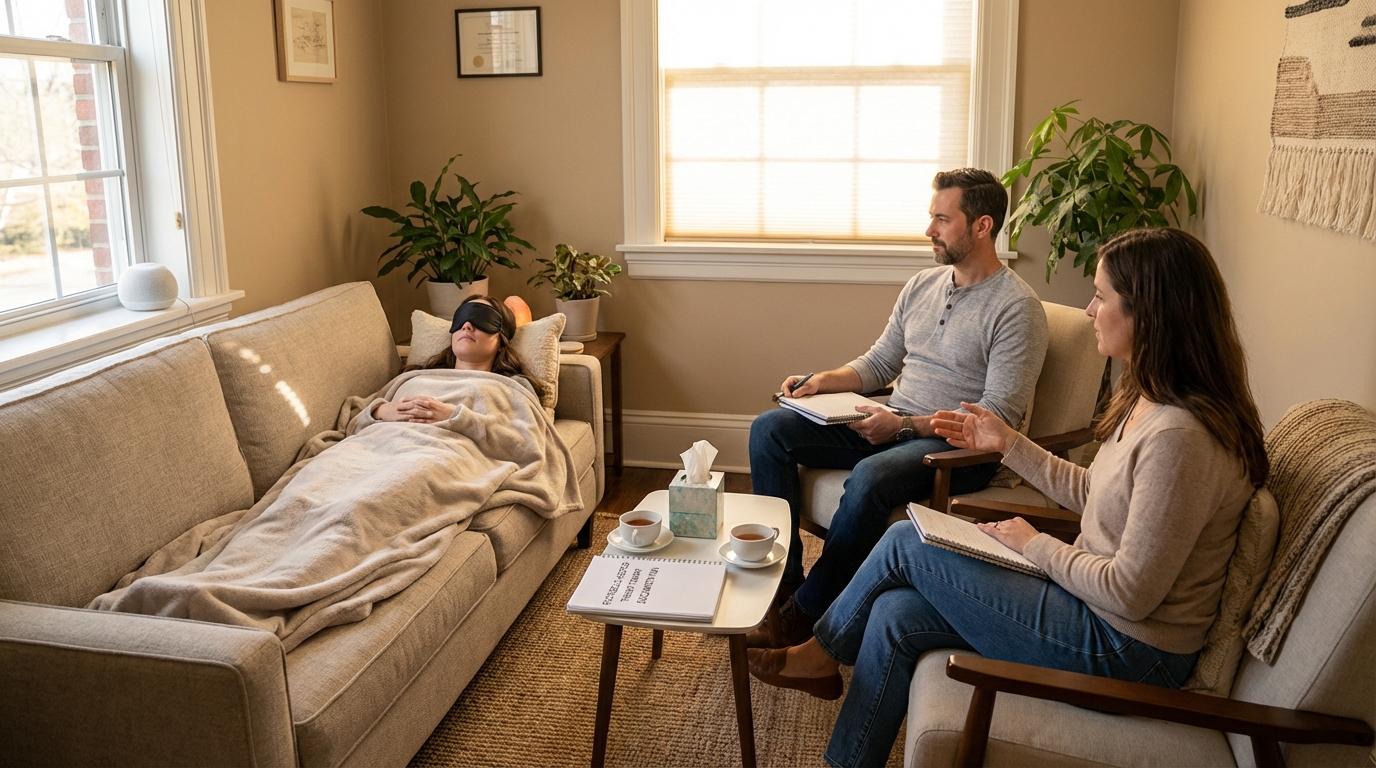
Clinical protocols for psilocybin therapy (generally adapted from depression and cancer anxiety protocols) would include:
Preparation: Discussing the specific social anxiety patterns — the situations feared, the underlying beliefs, the avoidance behaviors. Setting intentions around what you want to explore and understand. Building trust with the facilitator.
Dosing session: Typically 25–30mg psilocybin equivalent (high dose) in clinical trials. Eye mask and music guide the session inward. Social anxiety patterns may surface and be encountered differently from inside the altered state — often with less threat reactivity and more clarity about origin.
Integration: Working with what emerged — often a different understanding of the social threat and where it came from. CBT skills learned before the session may apply more effectively in the post-session plasticity window.
Who Might Benefit
Social anxiety that is:
- Treatment-resistant (hasn't responded adequately to SSRIs + CBT)
- Rooted in specific early experiences or beliefs that haven't shifted through standard therapy
- Accompanied by depression or generalized anxiety (common with SAD)
Social anxiety that may not respond:
- Social anxiety primarily driven by specific skill deficits (e.g., actual lack of conversational skills) rather than distorted threat appraisal — psilocybin doesn't teach social skills
- Social anxiety in the context of autism spectrum disorder may require different considerations (though the pilot study above showed benefit in this specific population)
Risks Specific to Social Anxiety
The session itself as a social anxiety trigger: Psilocybin sessions require being with a facilitator in a vulnerable state. For people with severe social anxiety, this situation can be acutely activating. Preparation sessions specifically addressing this fear, choosing a facilitator the person can genuinely trust, and having a slow, careful preparation process is particularly important.
Challenging interpersonal content: Psilocybin sessions for social anxiety may surface memories of embarrassment, humiliation, or social rejection — the experiences that conditioned the anxiety in the first place. This is therapeutically useful but requires a container strong enough to hold it.
Current Access
As of 2026, there are no established clinical protocols specifically for psilocybin + social anxiety treatment outside of research contexts. Options:
Clinical trials: Check clinicaltrials.gov for active social anxiety psilocybin trials. The autistic adults study has not yet produced a follow-up Phase 2 trial as of this writing.
Oregon service centers: Oregon licensed service centers can provide psilocybin access for any adult without a required mental health diagnosis. Social anxiety is a legitimate intention for a session.
Integration with CBT: If accessing psilocybin outside of clinical trials, working with a therapist who uses CBT for social anxiety before and after the session is recommended — the neuroplasticity window may enhance CBT effectiveness.