Psilocybin for End-of-Life Anxiety and Existential Distress
Death anxiety — the fear of dying, non-existence, and the loss of self — affects most people facing life-threatening illness, and many who are not. Conventional psychiatry has limited tools for existential distress: antidepressants treat mood symp...
Psilocybin for End-of-Life Anxiety and Existential Distress
Death anxiety — the fear of dying, non-existence, and the loss of self — affects most people facing life-threatening illness, and many who are not. Conventional psychiatry has limited tools for existential distress: antidepressants treat mood symptoms but don't address the underlying terror of mortality. Psilocybin-assisted therapy may offer something more direct.
The Clinical Evidence
The most important research comes from two landmark trials conducted at Johns Hopkins University and NYU Langone Medical Center in the 2010s, both studying psilocybin in cancer patients with life-threatening diagnoses and significant psychological distress.
Johns Hopkins Cancer Trial (2016)
Griffiths et al. enrolled 51 cancer patients with clinically significant anxiety or depression related to their diagnosis. Participants received either a high dose (22mg/70kg synthetic psilocybin) or a low active dose (1-3mg/70kg) in counterbalanced crossover design.
Results: After the high-dose session:
- 80% of participants showed clinically significant decreases in depressed mood
- 83% showed decreases in anxiety
- 67% rated the experience as one of the top five most personally meaningful experiences of their lives
- At 6-month follow-up, 78% continued to show significant decreases in depression; 83% in anxiety
- 65% met criteria for "complete remission" of depression
The effect sizes were extraordinary — substantially larger than those seen with conventional antidepressants or psychotherapy.
NYU Cancer Trial (2016)
Ross et al. at NYU conducted a similar double-blind crossover trial with 29 cancer patients. Results were comparable:
- Single psilocybin session produced immediate, sustained reduction in anxiety and depression
- Reductions persisted at 6.5-month follow-up
- 60-80% responded as "clinically meaningful" at multiple time points
The Follow-Up (2020)
A 4.5-year follow-up of the Hopkins participants found that the improvements were largely sustained. Most participants still rated the experience as among the most personally meaningful of their lives. Many reported continued reductions in death anxiety and improved quality of life.
What the Experiences Involve
Unlike antidepressants that dampen emotional reactivity, psilocybin often produces a direct confrontation with the existential questions that death anxiety raises — and frequently resolves them through direct experience rather than cognitive reframing.
Ego Dissolution and Death Anxiety
Many participants describe experiences resembling death of the self — what researchers call "ego dissolution." This is not always comfortable. But many participants who go through this experience emerge with a radically altered relationship to personal mortality:
"I experienced what felt like death — the complete dissolution of everything I considered myself. And then I was still here. Whatever I am was not what I'd thought I was. The fear after that felt... misplaced." — Hopkins trial participant
This is not a philosophical realization but an experiential one. The terror of non-existence often cannot be addressed at the level of argument; psilocybin may address it at the level of direct experience.
Unity and Connectedness
Researchers have documented a cluster of experiences under the term "mystical experience" that appear central to therapeutic outcomes in the cancer trials:
- Sense of unity or oneness
- Sacredness or awe
- Deeply felt positive mood
- Transcendence of time and space
- Sense of intuitive knowledge
- Paradoxicality (contradictions resolved)
Scores on the Mystical Experience Questionnaire (MEQ) from the session predicted therapeutic outcomes — specifically, the more profound the mystical experience, the greater the subsequent reduction in depression and death anxiety.
Mechanism Hypotheses
Why does a pharmacological intervention have such profound effects on existential distress?
The Neurological Account
Psilocybin reduces activity in the default mode network (DMN) — the brain network associated with self-referential thinking, rumination, and the narrative sense of self. Death anxiety is partly DMN-driven: the ongoing story of "me" and its anticipated termination.
When DMN activity is reduced, the tight identification with the narrative self loosens. This may be the neurological correlate of ego dissolution experiences and the subsequent reduction in death anxiety.
The Psychological Account
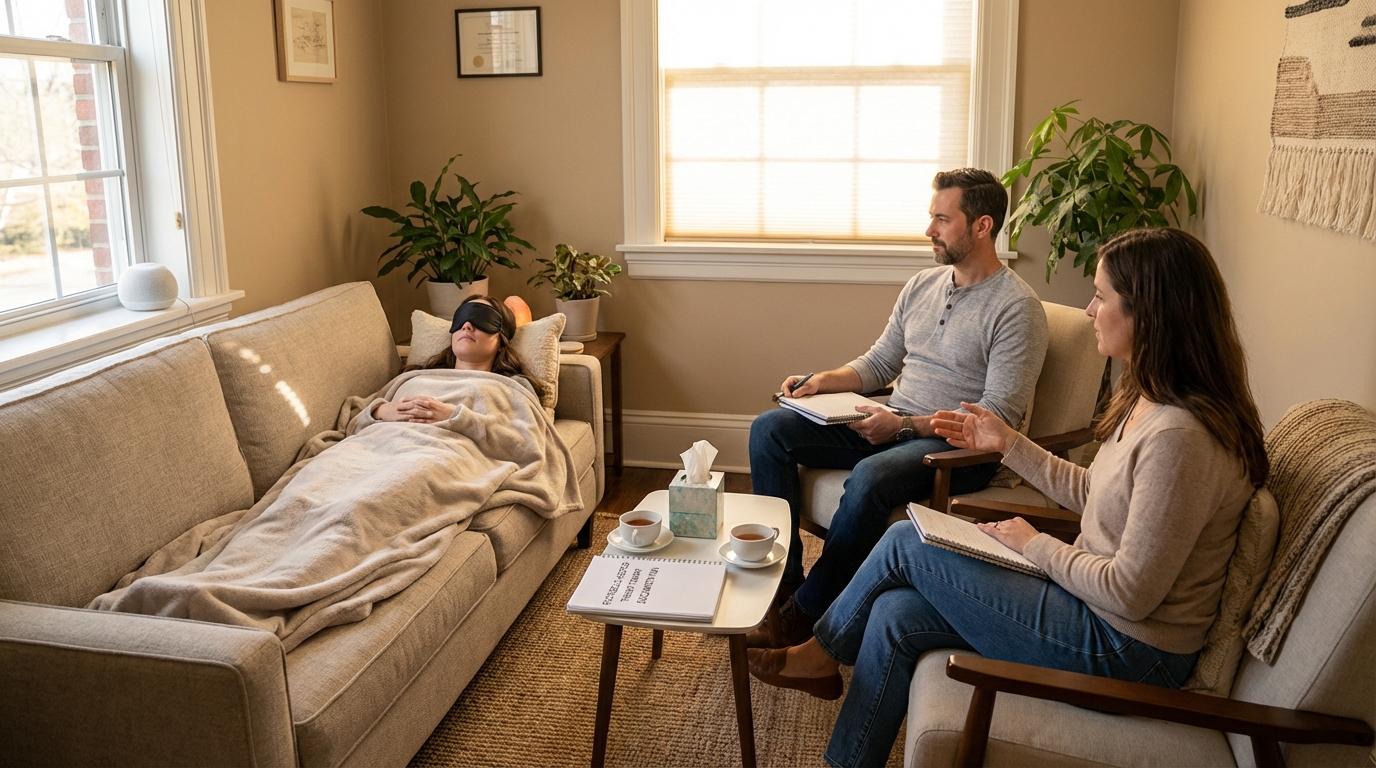
Psilocybin therapy for existential distress is not passive — it involves extensive preparation and integration. The psychological framework:
- Preparation: Establishing therapeutic alliance, exploring fears and values, setting intentions
- Session: Confronting existential material in an altered state with prepared support
- Integration: Making meaning of what arose; incorporating new perspectives into daily life
The psilocybin session provides material; therapy makes meaning of it.
Beyond Cancer: Healthy Volunteers and Death Anxiety
The Hopkins and NYU trials focused on cancer patients, but existential distress is not exclusive to terminal illness. A 2017 Hopkins study of psilocybin in healthy volunteers found that sessions facilitated a sense of interconnectedness and reduced fear of death even in participants with no life-threatening illness.
More recent work has examined psilocybin for "demoralizing grief" — the persistent sense of meaninglessness that can follow bereavement, even when standard grief criteria are not met. Early results are promising.
Practical Considerations
Access Pathways
For cancer patients and those with serious illness:
- Clinical trials: Several ongoing trials (search ClinicalTrials.gov for "psilocybin" and your condition)
- Compassionate use: In some jurisdictions, expanded access is available for terminal patients
- Oregon/Colorado: Licensed service centers offer sessions without a diagnosis requirement
- International retreats: Jamaica, Netherlands, Mexico offer legal access
Preparing for Existential Sessions
End-of-life psilocybin work requires exceptional preparation. Practitioners recommend:
- Thorough exploration of fears and unresolved issues before the session
- Discussion of spiritual and philosophical frameworks that resonate with the patient
- Explicit preparation for confronting death imagery or dissolution experiences
- Robust integration support, including ongoing therapy
Sessions addressing end-of-life themes should generally be facilitated by practitioners with specific training in palliative care or existential psychology in addition to psychedelic facilitation.
What Participants Report After
Across the clinical literature and qualitative studies, several themes emerge from participants who worked on death anxiety:
Perspective shift: Death is less of an ending; more of a transition or a fact integrated into a larger sense of meaning.
Present-moment orientation: Many participants report increased ability to be present — to experience life now rather than anticipating loss.
Relationship depth: Several participants reported the sessions motivated them to repair or deepen relationships, to express things previously unspoken.
Reduced suffering: The distress of dying is not the same as the fact of dying. Many participants report that while their prognosis hadn't changed, their suffering had reduced significantly.
What This Is Not
Psilocybin therapy for end-of-life distress is not:
- A cure for the underlying illness
- A guarantee of a positive experience
- Appropriate without thorough screening and facilitation
- Available everywhere (legal status varies significantly)
- Free of risk, especially for those with contraindicated conditions
It is a treatment for the psychological and existential suffering that accompanies life-threatening illness — suffering that, until recently, had few effective interventions.