Psilocybin and Nature: Ecological Connection as a Therapeutic Mechanism
Something consistent emerges from accounts of psilocybin experiences in natural settings: a felt sense of kinship with the living world. Trees, soil, animals, light — these stop being background and become participants. The experience is not metap...
Psilocybin and Nature: Ecological Connection as a Therapeutic Mechanism
Something consistent emerges from accounts of psilocybin experiences in natural settings: a felt sense of kinship with the living world. Trees, soil, animals, light — these stop being background and become participants. The experience is not metaphorical. For the duration of the experience, and often for some time after, the distinction between self and environment feels less rigid than usual.
This is not merely aesthetically pleasant. Researchers are beginning to take seriously the possibility that nature connection is a mechanism — not just a context — for therapeutic change.
The Research on Nature Connectedness
Nature connectedness (NC) is a measurable psychological construct — the degree to which a person feels part of the natural world rather than separate from it. Higher NC is associated with:
- Better subjective wellbeing
- Reduced depression and anxiety
- Increased prosocial behavior
- Greater environmental stewardship
- Reduced rumination and self-focused thinking
These associations hold across cultures and are not fully explained by physical activity or fresh air effects — the sense of belonging to something larger appears to be independently therapeutic.
Psilocybin and Nature Connectedness
A 2021 study published in the Journal of Psychopharmacology (Kettner et al.) found that psilocybin significantly increased scores on nature connectedness measures, with effects persisting at 4-week follow-up. The increase was comparable to the increases seen in long-term meditators.
A 2022 replication with a larger sample (Forstmann et al.) confirmed the finding. Nature connectedness scores after psilocybin sessions were predicted by the degree of ego dissolution during the experience — supporting the hypothesis that the mechanism is the dissolution of self-other boundaries, with nature being one domain where that dissolution is felt.
Why Nature and Psilocybin Work Well Together
Evolutionary Context
Humans evolved in natural environments over millions of years. The assumption that we are physiologically adapted to urban, indoor environments is historically anomalous. There is growing evidence for "biophilia" — an innate affinity for living systems — as a genuine feature of human psychology.
Psilocybin, which loosens the usual filters on experience, may allow a more direct experience of this affinity. What feels like a "new" experience of kinship with the natural world may be a recovery of something that ordinary adult consciousness suppresses.
Sensory Amplification in Natural Settings
Psilocybin dramatically amplifies the emotional and aesthetic significance of sensory experience. Colors appear more vivid. Textures become fascinating. Sound acquires dimension. In a natural setting, this means the already-rich sensory environment of forests, water, and open sky becomes genuinely overwhelming in its beauty.
Several therapeutic frameworks (Attention Restoration Theory, Stress Recovery Theory) document that natural environments restore attentional capacity and reduce stress responses through their inherent qualities — the fractal patterns of trees, the non-threatening aliveness of natural sounds. Psilocybin may amplify these effects.
Reduced Default Mode Network Activity
The default mode network (DMN), when suppressed by psilocybin, takes with it the constant self-referential narrative — the internal monologue about who we are, what we need, what threatens us. Without this narrative layer, direct sensory experience in nature becomes more accessible.
Many people describe experiencing a tree, a stream, or an open field as if for the first time — not because the sensory experience itself is novel but because it is not being processed through the usual screen of self-concern.
Outdoor vs. Indoor Sessions
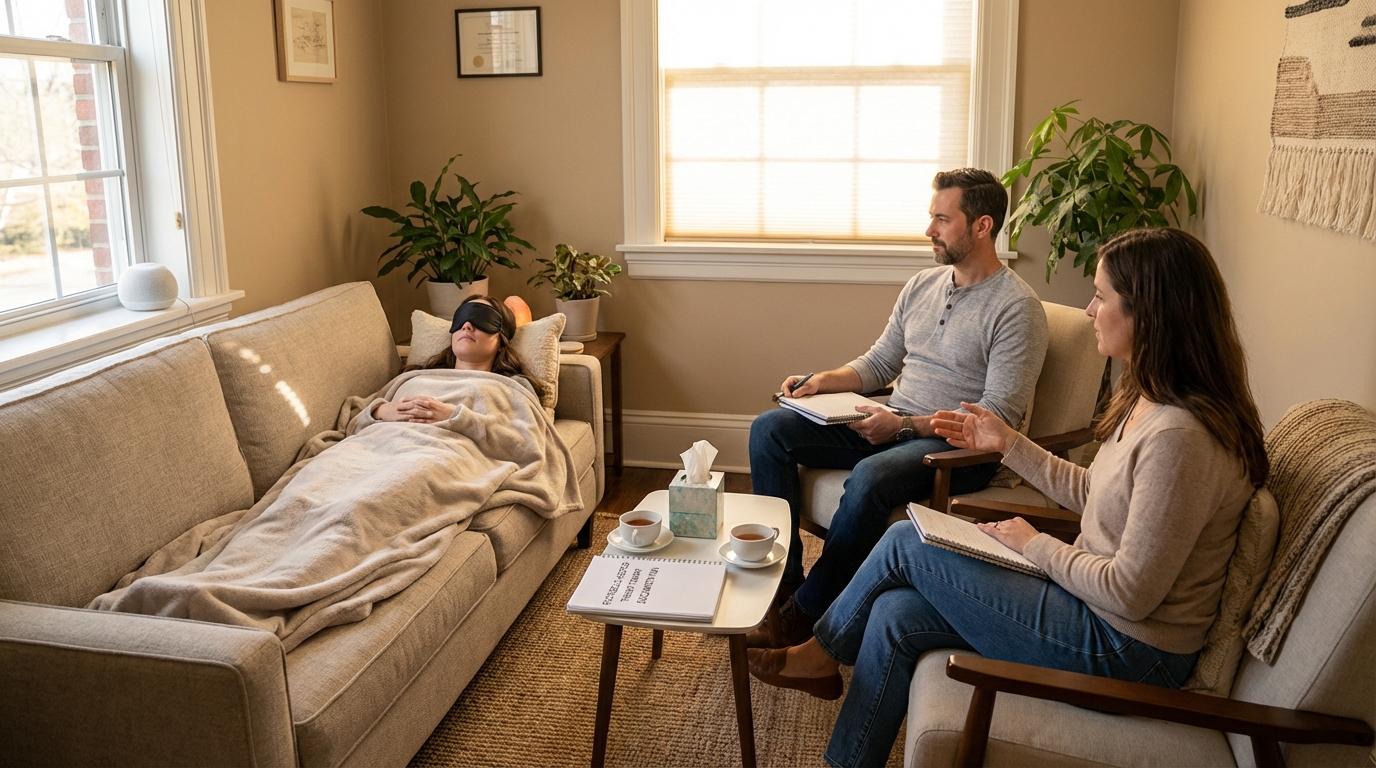
Most clinical psilocybin research has been conducted in indoor clinical settings — therapy offices, hospital rooms with artificial lighting and controlled environments. This is appropriate for establishing safety and efficacy; it's also limiting.
Outdoor session considerations:
Advantages:
- Natural sensory environment amplifies positive aspects of the psilocybin experience
- Physical contact with natural materials (soil, bark, water) provides grounding
- Movement is possible — lying in grass, walking slowly, sitting against a tree
- Reduced sense of confinement during difficult passages
Challenges:
- Weather and temperature require preparation
- Privacy and safety require appropriate locations (private land, experienced guides)
- Unexpected stimuli (other people, animals, sounds) can be disorienting during difficult phases
- Medical emergency response is more difficult in remote settings
Hybrid approaches: Some facilitators use indoor sessions for high doses (for safety and support access) while incorporating outdoor walks or time during the session for lower-dose or integration-phase work.
Specific Natural Settings
Different natural environments produce different experiential qualities. While set and setting always interact with individual psychology, certain patterns recur:
Forest: Old-growth forest in particular produces experiences of deep time, interconnection through mycelial networks (which people often feel as palpable), and a quality of being held. Many people report feeling that the forest is alive in a way that is not metaphorical.
Water: Bodies of water — ocean, lake, river — tend toward experiences involving dissolution, flow, and the relationship between form and formlessness. Ocean settings in particular can precipitate powerful ego-dissolution experiences.
Mountain/High altitude: Open views and elevated positions often produce clarity of perspective, reduced rumination, and a felt sense of scale that reduces self-importance in a constructive way.
Garden: For those who cannot access wilderness, private gardens provide a safe enclosed natural environment. The scale is manageable; the sensory richness remains significant.
Integration and Nature Connection
One of the most robust findings in psychedelic integration is that the post-session period is a window of neuroplasticity — a time when new experiences and practices are more likely to produce lasting change.
Spending time in natural settings during the integration period appears to reinforce and extend the therapeutic changes from the session. Specifically:
- Time in nature during integration appears to maintain elevated NC scores longer
- Physical contact with natural materials during integration supports embodied integration
- Regular outdoor time during the integration period correlates with better long-term outcomes in several observational studies
Integration practices combining nature:
- Morning walks without earphones, in parks or natural settings
- Sitting meditation outdoors
- Gardening as somatic and attentional practice
- Nature journaling — drawing or describing what you observe
- "Forest bathing" (shinrin-yoku) as a formal practice
Ecological Implications
The documented increase in nature connectedness following psilocybin has attracted attention from environmental psychology and conservation science. People with higher nature connectedness behave differently toward the environment — more conserving, more protective, more motivated to act on environmental issues.
Several studies have found that psilocybin users report increased environmental concern and behavior. A 2022 study (Forstmann & Sagioglou) found that psilocybin use predicted increased concern about environmental issues even after controlling for demographics and political orientation.
This is not an argument for psilocybin as an environmental intervention — the evidence is correlational and the ethical issues are significant. But it raises interesting questions about the relationship between psychological relationship to self, psychological relationship to other-than-human life, and pro-environmental motivation.
Cautions for Nature-Based Sessions
Safety first: Remote natural settings create real safety risks. A medical emergency in wilderness requires significantly more preparation than one in an indoor clinical setting.
Weather preparation: Cold, heat, or unexpected weather events can turn a manageable challenge into a dangerous one. Always plan for temperature regulation even in apparently mild conditions.
Wildlife: In regions with dangerous wildlife, session leaders must account for this risk.
Stay with your guide: Getting separated from a sitter while disoriented in outdoor settings is a genuine risk. Establish clear protocols before the session.
Appropriate dose: Lower doses (1-2g) are better suited to outdoor settings than high doses for those without extensive experience. The richness of the natural environment often makes lower doses more than sufficient.