Music and Psilocybin Therapy: Why What You Listen to Matters
Music in psilocybin therapy is not background noise. Research from Imperial College London and Johns Hopkins has established that the music during a session is an active therapeutic element — it significantly mediates the quality, depth, and thera...
Music and Psilocybin Therapy: Why What You Listen to Matters
Music in psilocybin therapy is not background noise. Research from Imperial College London and Johns Hopkins has established that the music during a session is an active therapeutic element — it significantly mediates the quality, depth, and therapeutic outcomes of the experience. Understanding why music matters, and what makes a good psilocybin playlist, is practically important for anyone preparing for a session.
The Research Establishing Music's Role
Kaelen et al. (2018, Imperial College): Used fMRI to show that participants' emotional responses to music were significantly amplified under psilocybin compared to placebo. Psilocybin dramatically increased the brain's emotional processing of music — particularly in limbic regions associated with meaning and memory. Music that felt moving became profoundly moving; music that felt mechanical remained mechanical.
Kaelen et al. (2021): Found that the quality of the music selected for a session predicted session quality independently of dose. Sessions with more carefully selected, emotionally and structurally appropriate music produced more positive and therapeutically valuable experiences.
Hopkins protocol: Hopkins clinical trials have consistently used the same music protocol — a carefully curated playlist designed by Hopkins researchers that has become the de facto standard for clinical psilocybin research. The playlist is available on Spotify as the "Johns Hopkins Psilocybin Research" playlist.
What Makes Music Work in Psilocybin Sessions
Emotional trajectory: Psilocybin sessions follow a natural arc — onset, building intensity, peak, gradual return. Effective session music mirrors this arc, with more grounded and calming music at onset, building complexity at the peak, and returning to grounded, spacious music during descent. Jarring or inappropriate music during the peak can destabilize the experience.
Wordlessness (mostly): Clinical protocols generally avoid music with English lyrics during peak effects, because language engages the analytical mind and can pull attention away from the experiential. Classical, ambient, and world music (where lyrics are in unfamiliar languages) tend to work better than English-language pop or rock.
Emotional resonance over familiarity: Music that has personal associations — your favorite album, songs from significant life events — may be too strongly associative to allow the experience to unfold freely. The Hopkins protocol deliberately uses music unlikely to carry personal associations for most American participants.
Structural diversity: A 6-hour playlist needs to carry an emotional arc without monotony. The Hopkins playlist moves through Western classical, Native American flute, ambient electronic, world music, and jazz — providing emotional variety while maintaining coherence.
Avoiding anxious music: Music that is tonally unresolved, rhythmically erratic, or emotionally anxious can amplify anxiety during sessions. The goal is music that is emotionally spacious, even when intense — music that holds rather than agitates.
The Hopkins Playlist Structure
The Johns Hopkins research protocol playlist (publicly available) follows this approximate arc:
- Pre-onset (0-45 min): Contemplative, meditative — Indian classical, Tibetan singing bowls, gentle ambient
- Onset/rising (45 min-2 hr): Building emotional intensity — baroque, orchestral with emotional depth
- Peak (2-4 hr): Fully orchestrated, emotionally complex, often cathartic — Bach, Beethoven, world music
- Descent (4-5.5 hr): Gradually spacious and grounding — ambient, jazz, folk
- Return (5.5-7 hr): Gentle, warmly textured — simple acoustic, gentle ambient
Wavepaths: Research-Based Therapeutic Music
Mendel Kaelen, who conducted the Imperial College music research, founded Wavepaths — a platform specifically for therapeutic music in clinical psychedelic settings. Wavepaths provides:
- Research-based music selection for different session phases
- Adaptive music that responds to session state
- Playlists designed for psilocybin, MDMA, and ketamine sessions specifically
- Clinical integration tools for therapists
Wavepaths is used in clinical research settings and is available to practitioners and individuals through subscription.
Practical Guidance for Session Music
If using the Hopkins playlist: This is the most researched starting point. Available on Spotify. Some find it too classical-heavy; it can be adjusted for personal fit.
Building your own playlist:
- 5-7 hours minimum
- Begin quiet and contemplative, build through the middle, return to grounded toward the end
- Minimize English lyrics during the peak
- Test music while sober to get a sense of its emotional texture
- Avoid songs with strong personal associations
Live music: Some ceremonial and therapeutic contexts use live music (chanting, guitar, bowls). Live music provides responsiveness to the participant's state that recorded music can't. If available with a skilled musician, this is often considered optimal.
No music: Some practitioners recommend periodic silence during sessions — particularly during intense emotional processing — to allow the experience to be heard without musical mediation. Complete absence of music throughout a session is unusual in research protocols.
Eye Mask and Music Together
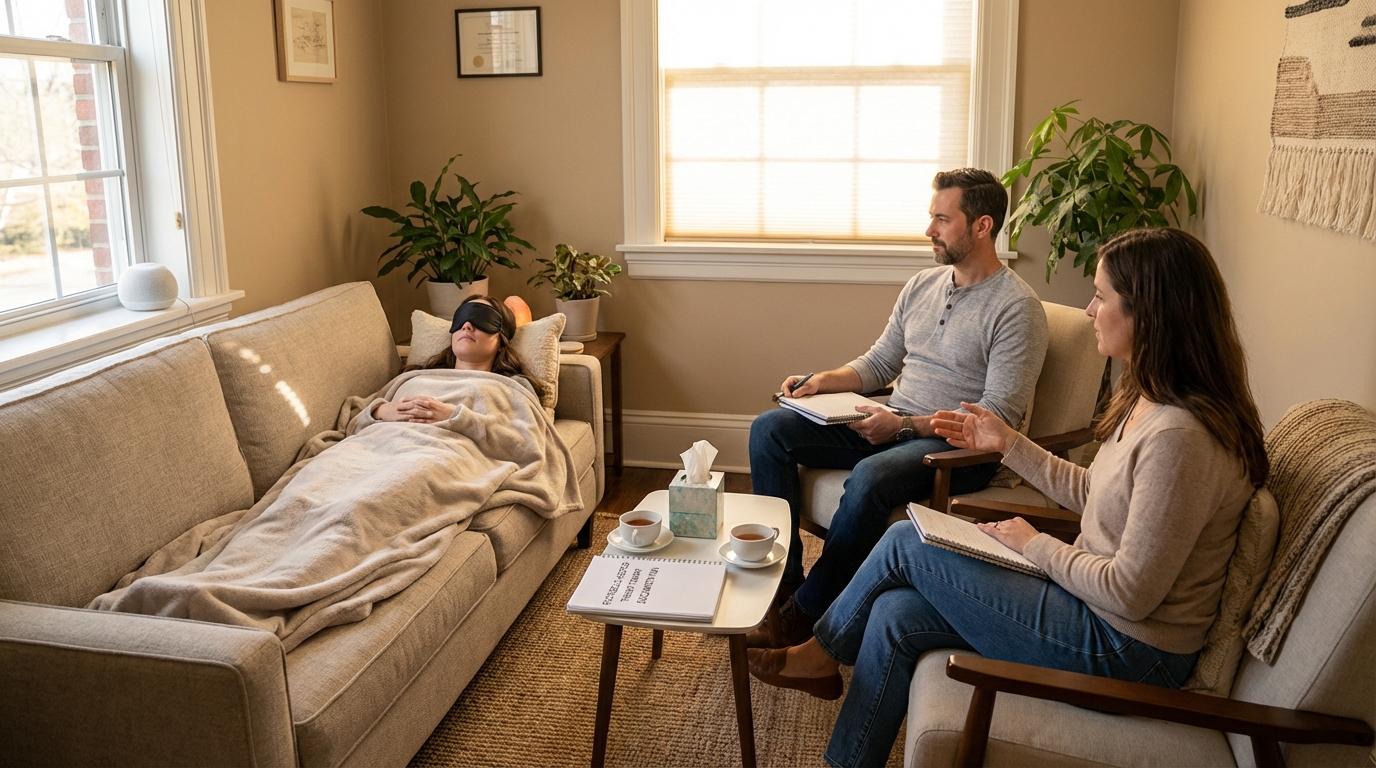
The Hopkins protocol pairs eye mask with music as complementary interventions. The eye mask encourages inward focus; the music provides a guide for the inward journey. Together they support the "trust, let go, be open" orientation that research shows correlates with better outcomes. Music without an eye mask tends to keep attention outward; eye mask without music can leave the experience without structure.