Navigating a Challenging Psilocybin Experience: A Complete Guide
Not every psilocybin experience is comfortable or pleasant. Difficult experiences — sometimes called 'bad trips' — are a normal part of the psilocybin landscape and, with appropriate support, can be among the most therapeutically valuable. Underst...
Navigating a Challenging Psilocybin Experience: A Complete Guide
Not every psilocybin experience is comfortable or pleasant. Difficult experiences — sometimes called "bad trips" — are a normal part of the psilocybin landscape and, with appropriate support, can be among the most therapeutically valuable. Understanding how to navigate difficult experiences — whether as someone having the experience or someone sitting with another person — is core harm reduction knowledge.
What Makes an Experience "Challenging"
Challenging psilocybin experiences include:
Psychological difficulty: Anxiety, fear, paranoia, confusion, encounters with traumatic memories, painful emotions, confrontation with death or meaninglessness, feeling trapped or unable to stop the experience.
Physical discomfort: Nausea, temperature dysregulation, physical tension, rapid heart rate, unusual body sensations.
Ego dissolution fear: The loss of the ordinary sense of self — common at higher doses — can be profoundly frightening if unexpected or unwelcome.
"Bad trip" content: Intrusive, disturbing imagery; encounters with aspects of the self that are painful; a sustained sense of terror or dread.
Important reframe: Research consistently shows that challenging experiences, when properly supported, often produce the most significant therapeutic outcomes. The difficulty is frequently the therapy. The goal of support is not to eliminate the challenging content but to help the person stay present with it rather than panicking.
The Evidence-Based Framework: Surrender
The most widely supported intervention for difficult psilocybin experiences is a set of principles that can be expressed in several ways:
"Let go and trust" — the Hopkins training phrase "Accept, let go, trust" — used in MAPS protocols "Turning toward rather than away"
The core insight across all of these: resistance amplifies difficult experience. Psilocybin-induced psychological content tends to become more distressing when fought or resisted, and tends to shift or resolve when met with openness or curiosity.
This is counterintuitive. The natural response to fear is to contract, resist, and try to escape. With psilocybin, this response intensifies the fear rather than reducing it.
Practical implementation:
- "I'm having a difficult experience. I can allow it to be what it is."
- "This is temporary. The medicine will pass."
- "What is this trying to show me?" (curiosity stance toward the content)
- Physical surrender: releasing physical tension, deepening breath, allowing the body to soften
The Sitter's Role During a Challenging Experience
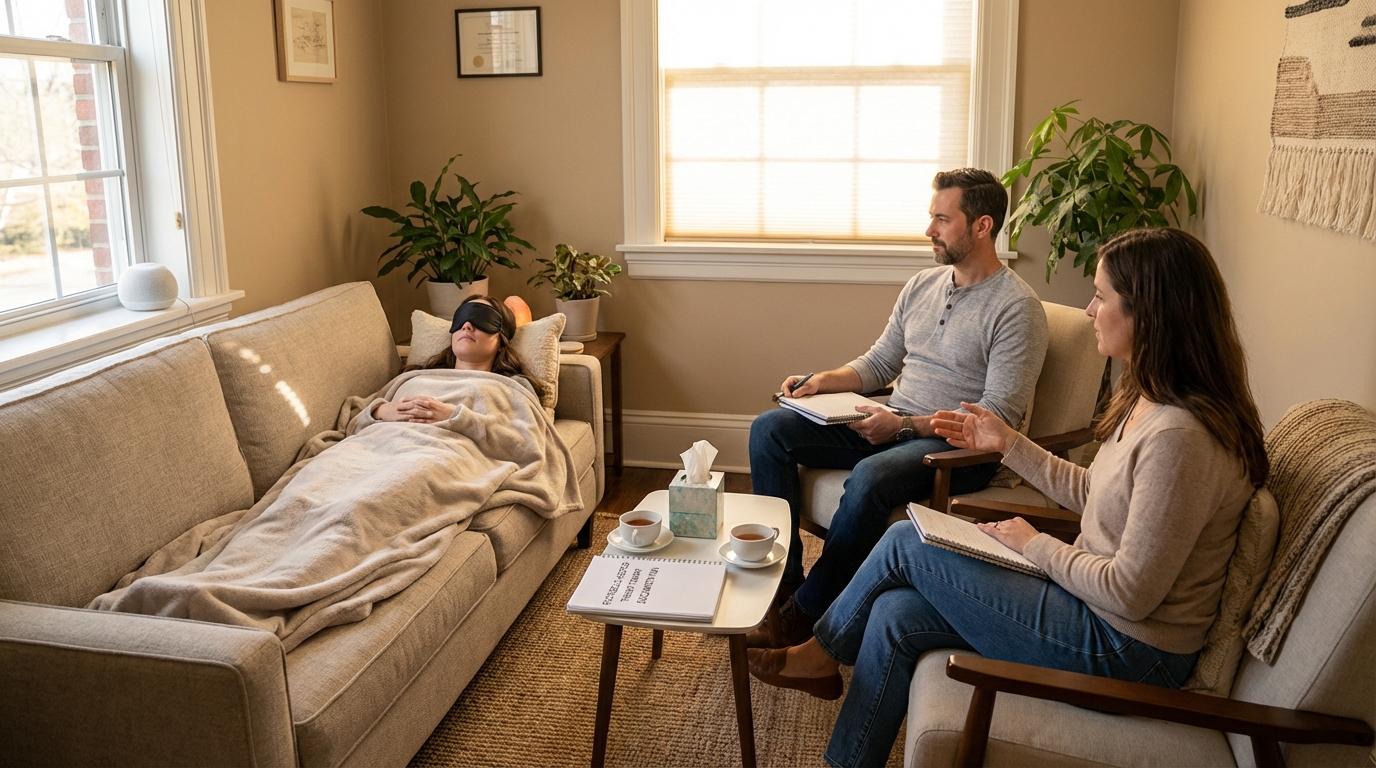
If you are sitting with someone having a difficult experience:
Regulate yourself first: Your nervous system state directly affects the person you're with. If you are anxious or alarmed, they will feel it. Take a slow breath. Remind yourself that difficult experiences are within the normal range. Your calm is the most important thing you can offer.
Physical presence: Sit close. Be available for physical contact (hand holding, a hand on the shoulder) — but ask before touching rather than touching without permission. Presence without intrusion.
Do not minimize or redirect: Saying "You're fine, it's just the mushrooms" is counterproductive — it invalidates what is real to the person's experience. Don't try to talk them out of the experience.
Responsive, not directive: Ask "What do you need?" rather than telling them what to do. Offer options: "Would you like music louder or quieter?" "Would you like water?"
Anchor with simple truths: If needed, simple factual grounding can help: "You took psilocybin. You're in a safe place. I'm with you. This will pass." Repeat calmly if needed.
Don't escalate: Not every difficult experience requires intervention. Monitor for genuine emergency indicators (see below) rather than treating all distress as a crisis.
Grounding Techniques During a Difficult Experience
Breath: Slow, intentional breathing is the most accessible and effective grounding tool. Breathe slowly and fully; the exhale activates parasympathetic response. Count breaths if that helps.
Physical sensation: Physical contact with the ground, feeling the texture of a blanket, holding something cold or solid. This brings attention to body sensation in the present.
Eyes open: If the experience feels overwhelming, opening the eyes and orienting to the physical room can reduce intensity. "The room is here. I am here."
Position change: Moving from lying down to sitting, or sitting to lying down, can shift the quality of the experience.
Voice: Speaking what is happening out loud to the sitter — narrating the experience — can reduce its grip. "I feel like I'm dissolving." Named things often feel less terrifying than unnamed ones.
Music change: A skilled sitter can adjust the music during a difficult passage — moving to more grounded, simple music if the current playlist is intensifying the difficulty.
What Is Not an Emergency vs. What Is
Normal range of difficult experience (not an emergency):
- Fear, anxiety, paranoia
- Crying, emotional release
- Distressing imagery or thoughts
- Feeling like the experience will never end
- Encounter with death or meaninglessness
- Ego dissolution — even severe ego dissolution
Indicators that may require emergency escalation:
- Inability to remain in the physical space safely (repeatedly trying to leave, run, or access dangerous areas)
- Behavior that could cause physical harm to themselves or others
- Sustained severe physical distress — difficulty breathing, chest pain, signs of cardiac event
- Failure to recognize that they have taken a substance after several hours (persistent psychosis-like presentation)
- Loss of consciousness or seizure
If emergency support is required:
- Fireside Project: 62-FIRESIDE — free psychedelic peer support, can assist by phone while in the experience
- MAPS Zendo Project: Psychedelic harm reduction at events, also has resources for support in non-event contexts
- Emergency services: Call 911 if there is clear physical emergency. In most jurisdictions, calling for help for a drug-related emergency does not automatically result in prosecution — "Good Samaritan" laws exist in many states for exactly this reason.
After a Challenging Experience: Integration
A difficult psilocybin experience does not end when the acute experience does. Integration — the process of working with the experience after it ends — is where the potential therapeutic value is either realized or lost.
Immediate post-experience (first 24 hours):
- Rest; don't immediately analyze
- Fluid intake and simple food
- Journaling the experience before sleep if possible — write what happened before you begin interpreting
- A short conversation with your sitter about what occurred
First week:
- Continue journaling; allow the experience to continue processing
- Watch for unexpected emotions surfacing
- Gentle physical practices (walking, yoga) support integration
- Be gentle with yourself and your schedule
Finding support:
- An integration therapist who has psychedelic literacy is valuable after a challenging experience
- Peer support: the Fireside Project offers ongoing peer support calls
- Integration circles: community spaces for sharing and processing psychedelic experiences
The reframe that helps: Many people who have had challenging psilocybin experiences and done integration work report, looking back, that the difficult experience was the most important one — that it surfaced exactly what needed to surface, in a way that nothing else had reached. This doesn't make it easier in the moment. But it places the difficulty in a context of potential meaning that integration work can help make real.
Challenging vs. Traumatizing
A challenging experience that is properly supported is unlikely to become psychologically traumatic. The factors most associated with lasting harm from difficult psychedelic experiences:
- No sitter present — unsafe conditions
- Inappropriate escalation — response to the experience that added fear (being hospitalized unnecessarily, criminal justice involvement)
- No integration support — leaving difficult material unprocessed
- Pre-existing vulnerability — psychosis history, bipolar I, active severe psychiatric illness
Proper preparation, appropriate support, and committed integration are not just comfort measures — they are the factors that determine whether a difficult experience becomes therapeutic or traumatic.