Psilocybin for Existential Distress: Confronting Mortality and Meaning
Existential distress — the anxiety, dread, and loss of meaning that can accompany a life-threatening diagnosis, aging, or profound confrontation with mortality — is one of the areas where psilocybin therapy has produced its largest and most consis...
Psilocybin for Existential Distress: Confronting Mortality and Meaning
Existential distress — the anxiety, dread, and loss of meaning that can accompany a life-threatening diagnosis, aging, or profound confrontation with mortality — is one of the areas where psilocybin therapy has produced its largest and most consistent effect sizes. This page reviews the evidence, mechanism, and clinical context.
What Is Existential Distress?
Existential distress includes:
- Death anxiety: Fear of dying, often distinct from pain or suffering fear, focused on the fact of non-existence
- Loss of meaning: The sense that life no longer has purpose or coherence in the face of serious illness
- Existential isolation: The feeling that one's experience of mortality cannot be shared or understood by others
- Hopelessness and demoralization: The collapsing of a sense of future
This is most commonly studied in the context of life-threatening cancer diagnosis, but it also occurs in other medical contexts (ALS, heart failure, HIV), in late-life existential crisis, and in the psychological aftermath of near-death experiences.
Existing treatments — antidepressants, psychotherapy, palliative care support — help but have modest effect sizes for the existential dimensions of distress specifically.
The Clinical Evidence
The psilocybin evidence for existential distress is among the strongest in the field:
Johns Hopkins (2016, n=51): A crossover RCT of high-dose psilocybin vs. very low-dose control in cancer patients with anxiety and depression. Results:
- 80% showed significant reductions in depression symptoms
- 83% showed significant reductions in anxiety
- Effects durable at 6-month follow-up
- 78% rated the session among the top 5 most meaningful experiences of their lives
NYU (2016, n=29): Parallel RCT using similar design. Results:
- 83% showed significant anxiety and depression reduction at 7 weeks
- 60–80% maintained benefit at 6.5-month follow-up
These effect sizes significantly exceed antidepressant benchmarks for existential distress in palliative contexts.
Why Psilocybin Specifically Affects Existential Fear
The mystical-type experience that psilocybin reliably produces — a sense of unity, transcendence of time and self, sacredness, and deep meaning — appears to directly address the structure of death anxiety.
Death anxiety is partly a function of the sense of self as a bounded entity that will cease to exist. The ego dissolution experience — in which the sense of a separate, bounded self temporarily disappears — seems to demonstrate experientially that identity is not as fixed and mortal as it appears in ordinary consciousness. Many participants describe a post-session conviction that something essential continues or that death as feared was not what they expected.
This is not a cognitive reframe. The shift appears to come from the direct experiential encounter — something that talk therapy, which operates in ordinary consciousness, cannot provide in the same way.
The Mystical Experience and Outcome Correlation
In both Hopkins and NYU data, the intensity of the mystical-type experience (measured by the Mystical Experience Questionnaire) is the strongest predictor of anxiety and depression reduction outcomes. Higher mystical experience = better outcomes, consistent across sites and studies.
This does not mean you must have a specific experience to benefit. But it does suggest that the character of the psilocybin experience — the depth of the altered state and the quality of insight — matters therapeutically.
The Session in Palliative Context
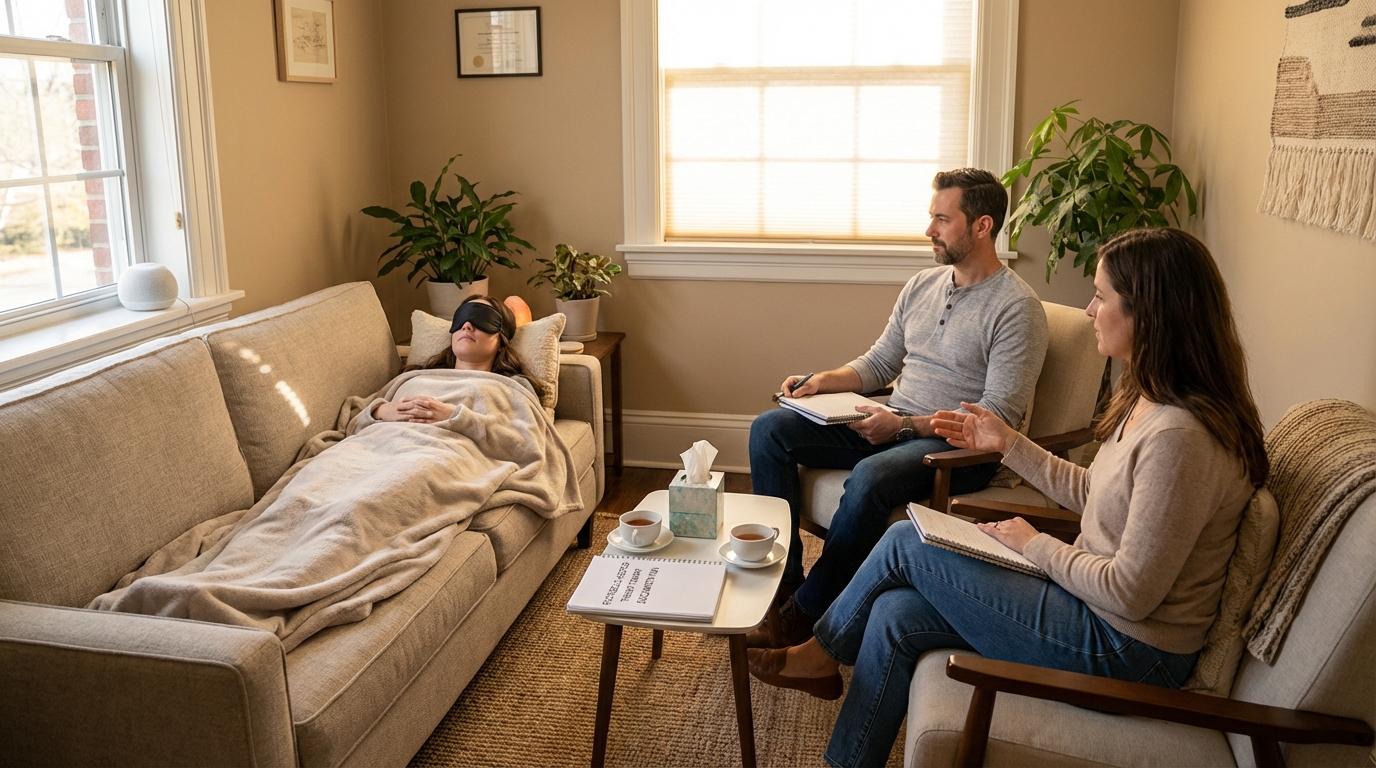
Psilocybin sessions for existential distress follow the same general protocol as other therapeutic applications, with attention to specific palliative needs:
- Extended preparation: Addressing fears and intentions, including discussions of death and what the patient is facing
- Medical coordination: With oncologists or palliative care physicians
- Dose: Typically 25mg psilocybin equivalent — a full therapeutic dose
- Session duration: 6–8 hours with two experienced guides/therapists
- Post-session integration: Processing the experience, reconnecting with meaning and relationship
Who This Is For
Existential distress psilocybin therapy is most evidently supported for:
- Cancer patients with anxiety and/or depression related to their diagnosis
- People with other life-limiting conditions facing mortality
- Anyone experiencing profound existential crisis who has engaged normal therapeutic options without sufficient benefit
It is NOT appropriate for people in acute delirium, active psychotic illness, or those with severe cardiac conditions (psilocybin produces transient blood pressure increases).
Access in 2026
Clinical trials: ClinicalTrials.gov — search "psilocybin cancer anxiety", "psilocybin existential distress"
Oregon service centers: Legal access; some facilitators specialize in palliative and end-of-life contexts
UCSF Dyadic Research Team: Pioneering palliative psilocybin work with caregivers and patients together
Resources
- Johns Hopkins Psychedelic Research: hopkinspsychedelic.org
- MAPS: maps.org — information on psychedelic therapy access
- Palliative Care Network: Access to palliative specialists who may have psilocybin research connections
- Fireside Project: 62-FIRESIDE — crisis peer support