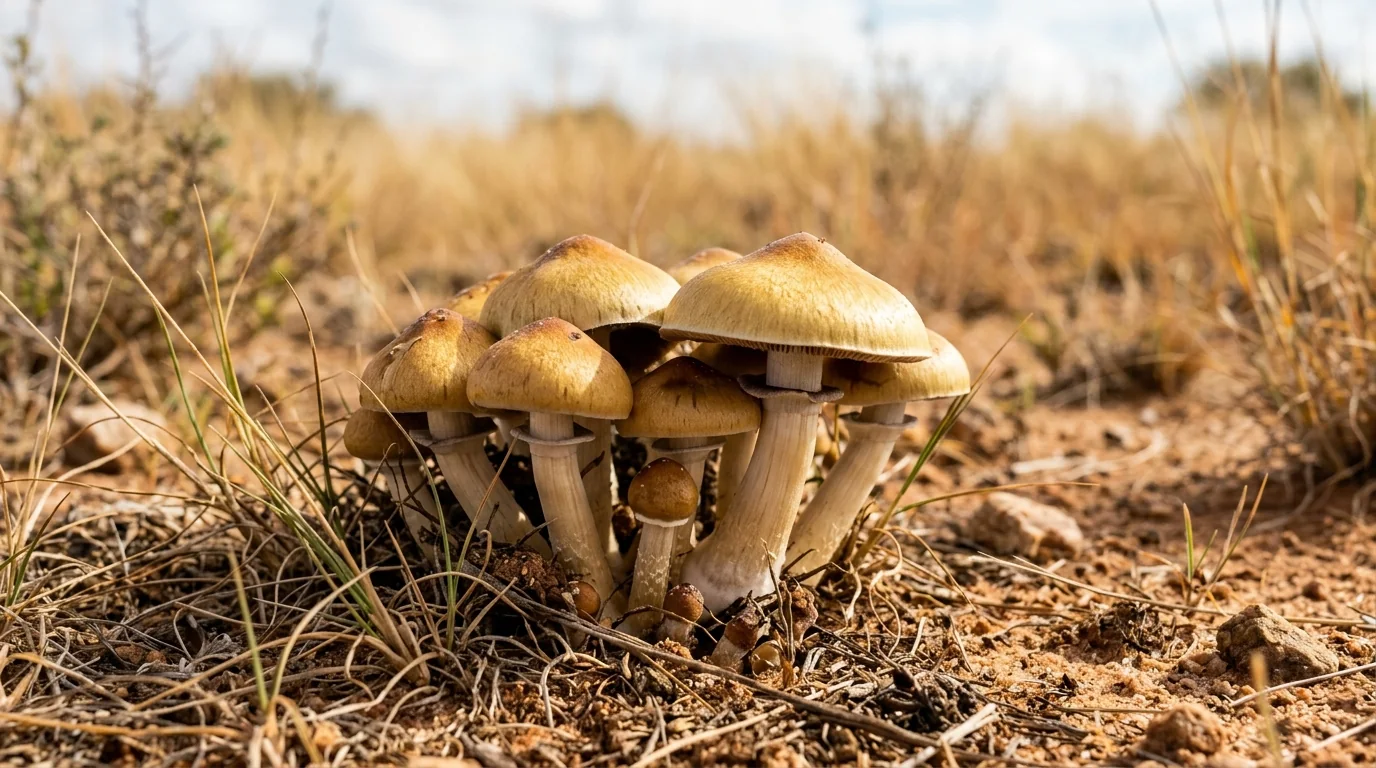
Kalahari Mushroom Strain
Overview
Kalahari is a Psilocybe cubensis strain originating from wild isolates collected in or near the Kalahari basin — the semi-arid savanna spanning Botswana, Namibia, and parts of South Africa. Its collection from a drier, more climatically extreme environment than typical tropical cubensis habitats has contributed to its reputation for distinctive genetics and above-average potency, aligning it with the broader pattern of southern African isolates such as Transkei and Cape Town. Kalahari produces medium to large fruiting bodies with golden-brown caramel caps. It is among the rarer African cubensis strains in global spore distribution, valued by collectors interested in the full spectrum of African lineages.
Effects & Experience
Kalahari delivers a strong, clear-headed psychedelic experience consistent with the South African cubensis profile — above-average intensity, strong visual enhancement, and meaningful introspective depth. The experience is described as grounded and purposeful rather than overwhelming, with a character that suits intentional use contexts. Potency is meaningfully above beginner strains.
Potency Profile
Above average — estimated 0.9–1.3% psilocybin by dry weight. Consistent with the southern African cubensis category. Apply the same dose conservatism as Transkei or Cape Town.
Cultivation Notes
Kalahari is accessible to beginners despite its above-average potency. Colonization is reliable on standard grain and bulk substrates. Fruiting is consistent without aggressive triggering. Performs well on PF Tek and monotub. Tolerates minor environmental variation. The strain's rarity in the spore market makes agar work and careful culture maintenance important for preserving genetics between grows.

Recommended methods: Pf Tek, Monotub Tek